The Salina Public Entities (SPEs) — the City of Salina, Salina Airport Authority, Kansas State University and Salina USD 305 — Friday reaffirmed their continued commitment to completing the environmental cleanup at the former Schilling Air Force Base and protecting the Salina community.
According to the Salina Airport Authority, the Kansas Department of Health and Environment (KDHE) is the state’s lead regulatory agency for the Schilling cleanup, and major designs, work plans and field activities require its review and approval. At KDHE’s direction, substantial progress on the overall project has been placed on hold and the SPEs await additional information and guidance from the agency.
The delay is due to KDHE conducting a Data Gap Analysis, an internal technical review the agency has said is warranted to verify its original site investigation and findings. The SPEs have been coordinating closely with KDHE leadership, including a July 2026 meeting in Topeka with KDHE Secretary Janet Stanek and senior staff, to support timely completion of that review. KDHE has indicated the analysis is expected by October 2026.
Public health remains the SPEs’ top priority throughout this temporary delay. From the time the CAD was issued in 2019, the SPEs have consistently monitored the groundwater and air quality at and around the site. The most recent monitoring event occurred in August 2026. The monitoring data has consistently shown that (1) the City’s water supply is not in imminent danger of impact from the groundwater plumes and (2) the people that live, work, go to school, and visit the areas overlying the plumes are not being exposed to unsafe conditions. The SPEs continue to closely monitor the site conditions.
Background
The environmental investigation of the former Schilling Air Force Base has been underway for decades.
Beginning in 2013, the SPEs and their environmental consultant, Dragun Corporation, conducted approximately five years of focused investigation that built upon earlier work completed by the U.S. Army Corps of Engineers, the U.S. Environmental Protection Agency and KDHE. That work was intended to determine the nature and extent of contamination and evaluate options for cleaning up the former military property.
Following that investigation and review process, KDHE issued its Final Corrective Action Decision, or CAD, in July 2019. The CAD is the state’s formal decision identifying the cleanup remedy for the former Schilling Air Force Base.
In issuing the CAD, KDHE determined that its directed cleanup actions would protect human health and the environment, meet applicable requirements and provide cost-effective performance. The approved remedy included treatment of contaminated soil and groundwater, barriers designed to prevent further movement of contamination, land-use controls, routine monitoring, and other cleanup measures.
The CAD then became a central part of the settlement between the SPEs and the United States. Under a 2020 Consent Decree approved by the U.S. District Court, the federal government paid $65.9 million toward the cleanup, and the SPEs agreed to carry out the response action identified in the CAD.
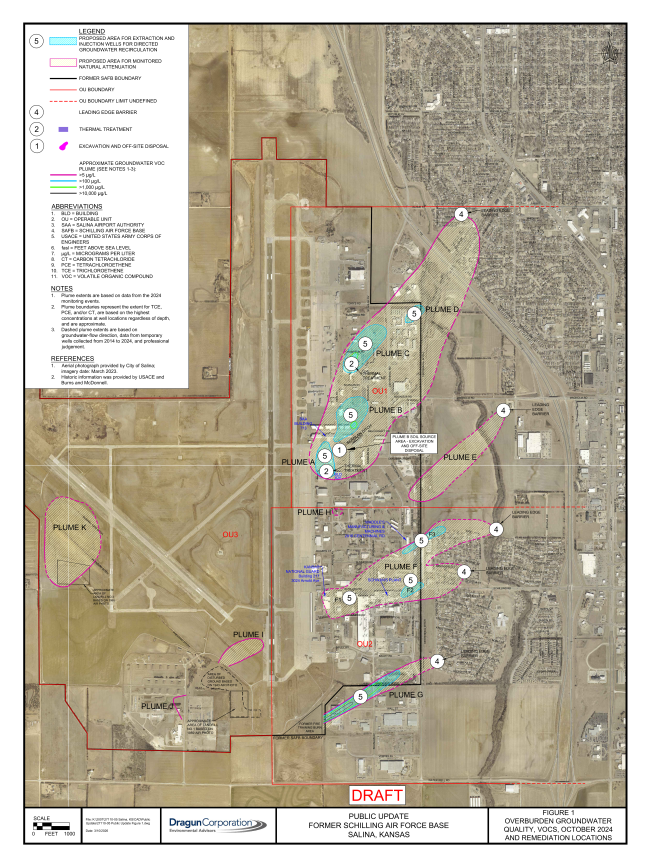
For the last six years, the SPEs have been planning, designing, and implementing cleanup based on the remedy selected and approved by KDHE. Prior to the requested pause in the remediation design work, the SPEs completed remediation of the Plume B Soil Source Area. The cleanup process involved removal of impacted soil from the source area, conducting confirmatory sampling, backfill of the excavation with clean fill, and disposal of the soil at the Salina Landfill. In addition, significant investigation and design of additional remedial actions outlined in KDHE’s Corrective Action Decision (CAD) have been completed, including technologies to address additional source areas, prevent the further migration of the groundwater plumes, and remediate the groundwater plumes.
How the project reached its current status
In April 2025, KDHE transferred oversight of the Schilling project from its State Cooperative Program to the Federal Facilities Program without advance notification to the SPEs. That transfer followed a period of significant turnover in project oversight, with 15 different KDHE project managers assigned to the Schilling cleanup since 2013.
Following the transfer, Federal Facilities staff began conducting an internal review of the agency’s previous work and decisions. In August 2025, KDHE formally requested a temporary pause on further efforts at the site while it conducted the Data Gap Analysis. This analysis allows KDHE to evaluate the quality and completeness of its data, ensure all former landfill sites have been identified, and address needs related to PFAS (“forever chemicals”), which was not widely recognized as an environmental concern when the original CAD was issued.
KDHE initially indicated that it would provide the SPEs with the results of its review by October 2025. That analysis was later delayed until December 2025 and then delayed again until April 2026.
When the April timeframe passed without delivery of the analysis, the SPEs requested an in-person meeting with KDHE leadership in Topeka to discuss the continuing delays, better understand KDHE’s concerns and establish a clear path for moving the project forward.
That meeting was held on July 7, 2026, and included representatives of all four SPEs, their legal counsel and environmental consultants, elected and state officials, KDHE Secretary Janet Stanek, and senior KDHE staff and legal counsel.
The meeting focused on clarifying the issues preventing the project from advancing, establishing specific responsibilities and identifying a schedule for KDHE to complete its analysis.
At the conclusion of the meeting, KDHE committed to completing the Data Gap Analysis by the end of August 2026, followed by a meeting with the SPEs to review the findings and determine what additional investigation or changes, if any, may be necessary. KDHE has since requested until October 2026 to deliver its findings. Completion of the Data Gap Analysis is required before KDHE grants approval for work to resume.
The path forward
KDHE and the SPEs share a common goal: ensuring the previously approved remediation design comprehensively addresses the cleanup needs and supports long-term public health and safety. The SPEs look forward to collaborating with KDHE upon completion of its review and to restarting work on the currently approved plan — or implementing any required changes — within the allowable project budget and original schedule.
The SPEs have responsibility in ensuring remaining settlement funds are used appropriately. Continuing substantial design or construction before KDHE completes its review could create unnecessary costs if previously planned work must later be changed.
At this point, the key outstanding action necessary to restart substantial progress is KDHE’s completion of its technical review and Data Gap Analysis.
Once that information is received, the SPEs and their consultants can work with KDHE to determine what additional work is required, what it will cost and how quickly the cleanup can move forward.
The SPEs will provide another public update after KDHE’s analysis is received and the next steps are known.