Orbiting hundreds of miles above Earth, the International Space Station feels worlds away. But for seven Kansas State University Salina seniors, an ambitious capstone project brought the microgravity laboratory to America’s heartland for youth to experience.
As part of the students’ senior capstone project, they collaborated to design, develop and build an immersive experience through computer coding, virtual reality, or VR, and augmented reality, or AR. The game is called “ISS: Rupture,” an interactive game that simulates fixing micro air leaks — a complex, real-life scenario that astronauts aboard the International Space Station, or ISS, may encounter.
Players in the game navigate through the space station in zero gravity and use a sonic air-leak detection tool to find micro-air leaks caused by small dust particles striking the space facility.
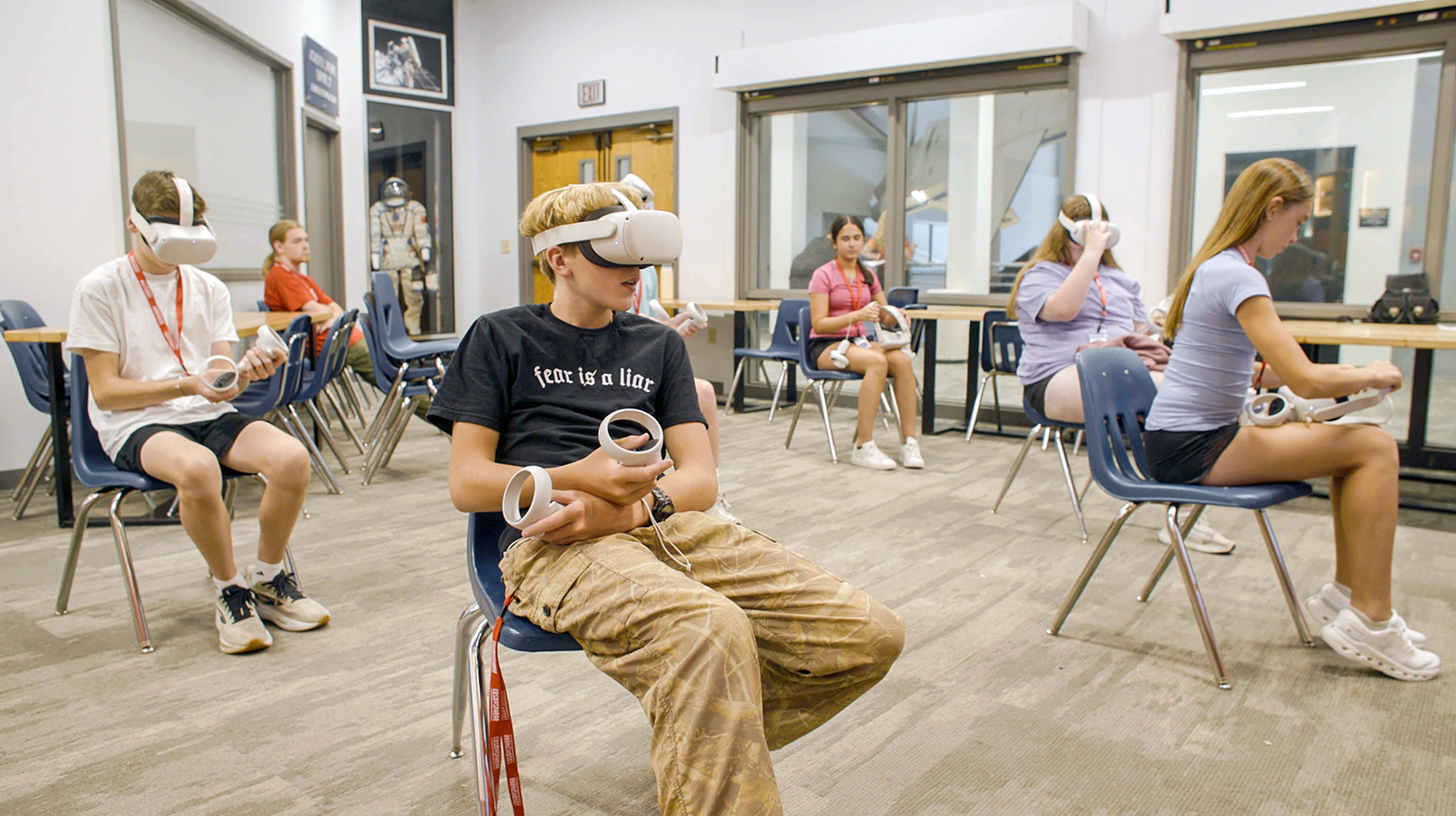
Instead of training astronauts who are blasting off into space, “ISS: Rupture” is designed to inspire the next generation of explorers, giving Kansas youth an immersive way to experience STEM education through summer camps at the Cosmosphere in Hutchinson. Camp attendees in grades K-12 traded in their pencils for VR headsets to learn about space without the hassle of a protective, pressurized suit, providing a camp experience like no other.
The K-State Salina student developers traveled to Hutchinson to showcase their developments, present the game and consult with Cosmosphere staff on how to utilize the program for a presentation during the spring semester’s finals week in May.
Although each student brought a unique passion for technology to the project, success depended on teamwork. Students in the computer systems technology program worked alongside peers in the cyber systems design and dynamics program, blending skills in coding, virtual reality, digital media, machine learning and autonomous systems to bring their ideas to life.
“The Cosmosphere was proud to partner with K-State Salina on this project,” said Claire Ludes, Cosmosphere senior vice president and chief development officer. “Partnerships with highly acclaimed educational institutions such as K-State Salina help us provide established interest and career paths for our CosmoCampers. The project has been mutually beneficial, granting university students the opportunity to work on a unique deliverable in the VR space, while the Cosmosphere is able to continue pushing the limits of our educational programs and experiences.”
‘I’m going to try to break the game!’
For the seven K-State Salina students who developed the “ISS: Rupture” game for the Cosmosphere, the process of perfecting the game was arduous and tested their skills, patience and teamwork.
Ahead of pitching the game to the Cosmosphere, the students had to ensure the game they developed would be workable for the museum. This required plenty of testing, but the students had no difficulty recruiting eager players of all ages, abilities and familiarity with VR technology from the ranks of K-State Salina faculty and staff members’ children.
Together, they worked to find any remaining bugs in the game.
“The one thing that I heard the most was ‘I’m going to try to break the game,’ and they would do anything, like try to find a wall that would have been covered up and just go through it or throw a leak detector into the air,” said Zabdiel Ramirez, senior in computer systems technology, Russellville, Arkansas. “It was a huge help to have children as test subjects because it allowed you to see how they thought and what issues they could present that we wouldn’t have thought of, and we’d get them fixed.”
One issue the students quickly discovered was the difficulty testers had in picking up items like the air leak detector wand used throughout the game. Picking items up requires using VR controllers, something the students had experience with, but the testers did not. They found that younger children with less experience using VR systems struggled to grab items they needed to complete the game, which posed further challenges later in the game.
This discovery caused the students to also simplify the game, so it was easier to use for children and first-time VR users.
Although it was a long process, the student team is eager to see something that they developed educate youth from all over the state.
“It’s very exciting, because it’s the first time that we created something that students will be using at Cosmosphere,” Ramirez said. “And what is cool is this partnership with the Cosmosphere will provide the opportunity for senior-level technology students in the next academic year to take feedback from the Cosmosphere and use it to build and enhance the game, so it continues to meet their needs. It’s a good feeling to have created a game that will be used by Kansas youth for years to come.”
While the first wave of K-State Salina student developers weren’t able to get everything that they had hoped for in the game, they still were able to produce some amazing virtual content that has already captured the imagination of youth — not just those who enter the Cosmosphere, but also those who helped develop the game.
Where technology meets real-world experience
While preparing the game for the Cosmosphere involved plenty of trial and error and constant communication, the project gave students valuable experience beyond the classroom and a glimpse into the realities of working in the technology industry.
While K-State Salina students often use VR headsets for classwork and projects on campus, the technology runs much deeper than meets the eye.
Students at K-State Salina are becoming experts with state-of-the-art technology programs like Unreal Engine 5, Blender, After Effects, Photoshop and more. Unreal Engine 5 in particular allows students to create design visualizations and cinematic experiences in high-quality games across PC, console, mobile, VR and AR platforms. Students studying in K-State Salina’s immersive systems design program become experts utilizing Unreal Engine 5 by creating 3-dimensional worlds, characters and animation, simulation and effects, and more.
“My favorite part of the project was learning the cinematic editing session within the Unreal Engine program’s sequencer,” said Mendoza. “It’s where a lot of the animations, camera, lighting and multi-layer arrangement take place. Since I’m familiar with After Effects, the correlations were similar but unique in their own way. It’s something I’ve been exploring a lot more lately, and it’s very fun.”
The K-State Salina students were excited to use their education to develop an innovative game they could point to on their resumes, but they also developed other skills through this project that will help them in the future.
The students had the opportunity to showcase their creativity in coding and VR design, but they were also able to gain real-world, industry-level experience by working closely with a client — in this case, the Cosmosphere — learning to effectively balance the client’s requests with the timeline they were given.
Professional and interpersonal skills like these are tough to replicate in the classroom but are critical to becoming competent and well-trained professionals, said Michael Oetken, assistant professor in K-State Salina’s immersive systems design program.
“Students spend a lot of their time in classes and labs learning new technologies and working on things they’re naturally interested in,” Oetken said. “But outside of those technical skills, they also need the professional skills that will make them good teammates and collaborators.
“I also think interacting with a real client was valuable because many of the students had never had that experience before,” Oetken continued. “Having that level of interaction gave them an opportunity to become more comfortable and confident. When they eventually move into a professional job, they’ll be much better prepared to communicate with clients and colleagues without feeling as nervous or unsure of themselves.”
Ramirez said he gained a better appreciation for software development beyond the ability to write code.
“You must be able to explain technical concepts to people who may not have a programming background, test and refine your work, and collaborate with teammates who each bring different skills to the table,” Ramirez said. “Those are experiences that I know will be valuable as I pursue a career in software development.”
Projects like “ISS: Rupture” demonstrate how K-State Salina is connecting students, industry partners and emerging technology to create experiences with impact far beyond the classroom. Through immersive systems design, K-State Salina students are preparing to shape the future of aerospace, entertainment, education, healthcare, manufacturing and other technology-driven industries.
The game’s developers include Alec Mendoza, senior in digital media technology, Dodge City; Jacob Klataske, senior in digital media technology, Galva; Diego Hinojosa, senior in engineering technology, and Dylan Hoeffner, senior in computer systems technology, both from Salina; Will Ramberg, senior in computer systems technology, Topeka; Zabdiel Ramirez, senior in computer systems technology, Russellville, Arkansas; and Hunter Taylor, senior in mechanical engineering technology, Holdrege, Nebraska.