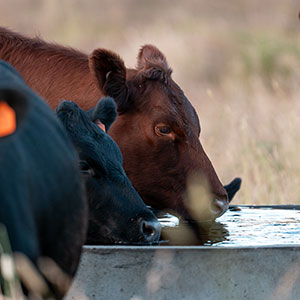
Water is likely the most important nutrient in raising livestock, and yet Kansas State University Extension cow-calf specialist Jason Warner says it is often the most overlooked.
“A big reason why many of our pastures and rangelands go underutilized is simply due to a lack of access to high-quality, abundant water resources,” Warner said.
Warner said many beef operations in Kansas and similar regions do not have abundant groundwater or access to rural water systems. Instead, they rely heavily on surface water sources to supply their cow-calf herds, stocker cattle and replacement heifers. Springs, ponds and other natural sources such as creeks and streams are a critical part of the ranch’s bottom line and long-term sustainability.
“If we think about a ranch or an operating unit that has underdeveloped water resources versus one that has developed and high quality and abundant watering resources, that can certainly add a tremendous amount of value to that operation just in and of itself,” Warner said.
Among the most cost-effective tools for farmers and ranchers are spring boxes, structures that capture natural spring flow and direct it into a tank, small pond or trough. Warner said spring boxes are relatively easy to develop and can provide dependable water when properly designed and maintained.
At the same time, he urged producers to regularly check existing springs and spring boxes for reduced flow or leaks.
“If you have those types of watering resources on your operation, and you notice that the spring spring box is not holding water — or the spring is not flowing — as much as they should, there can be a number of different reasons,” Warner said. “It’s important to take the time to look at those resources … and what steps you might need to take in order to be able to appropriately address and correct that issue.”
Stacy Minson, a K-State Extension watershed specialist in the Kanopolis Watershed in west-central Kansas, said the university’s extension network is designed to support ranchers tackling these types of water challenges.
“One of the best things about extension, as a watershed specialist or even extension staff, is having the ability to reach out if a rancher reaches out to one of us or to an office,” said Minson, who is coordinator of the university’s Watershed Restoration and Protection Strategies (WRAPS) program. “Farmers and ranchers can do a lot of things on their own, (but) sometimes they do need that additional expertise.”
Warner tied water development directly to broader goals of grazing distribution, forage utilization and regenerative agriculture. Underdeveloped water is a key reason why cattle often overgraze near existing tanks or ponds while leaving distant forage largely untouched.
Improved water distribution, he said, helps spread grazing across a pasture, improving soil health, reducing erosion, limiting invasive species and supporting the ranch’s regenerative goals.
“When we improve our grazing distribution, not only do we improve our soil health, but we also can help minimize our erosion and losses of our key natural resources,” Warner said.
Warner also emphasized water conservation as a growing priority for agriculture.
He pointed to leaky tanks, pipelines and spring boxes as examples of where operations may be losing water they cannot afford to waste.
Farmers and ranchers are encouraged to view an online publication, Waterers and Watering Systems: A Handbook for Livestock Producers and Owners, available from the K-State Extension bookstore. The handbook can be downloaded and covers water and power source options, water transport systems, waterer types, and more.
More information on managing livestock and other agricultural topics is available at local K-State Extension offices in Kansas.