“Thirty Pigs and a Plan.” That phrase describes one man’s modest agricultural beginning that would ultimately lead to the creation of a multi-million dollar family agribusiness based in rural Kansas.
John and Janie Kramer and their family members are the owners of J-Six Enterprises, a diversified agribusiness in northeast Kansas. The business’ origins are described in author Joe Brinnon’s book titled “Thirty Pigs and a Plan: The John Kramer Story.”
John Kramer was born on a farm near Corning, south of Seneca. It was a challenging childhood, but John was always interested in farming. In high school, he met Janie Talley.
Kramer went to K-State, made the football team as a walk-on, and graduated with a degree in animal science while Janie attended nursing school. They married and moved to Illinois where Kramer worked for a hog producer.
His long term plan was to build a successful agricultural business so that his children and grandchildren could have a career in agriculture if they chose. In 1971, the Kramers moved back to northeast Kansas with 30 hogs and a plan. They started producing pork. It was a small beginning, but Kramer had a plan to build the business – and he did so.
After riding the ups and downs of hog markets – and surviving tornadoes and market crashes in the ensuing years – Kramer pursued diversification. This began with purchasing local grain elevators and grew into other strategies to capture more value in the processing and marketing of ag products.
“(My) dad played an integral role in getting a pork processing plant built in St. Joe,” son Joe Kramer said.
The family business became known as J-Six Enterprises. It has grown tremendously through the years. “We’ve evolved into value-added agriculture, beginning with mineral mixes and moving into pet food,” Kramer said.
This is truly a family business with multiple divisions. John Kramer’s youngest brother, Troy, is in charge of sales and business development.
John and Janie’s sons and daughter are responsible for various aspects of the company. Jeff Kramer is in charge of milling operations. Joe Kramer is in charge of finance and the land division. Daughter Jenny married Dan Gerety, who is now CEO. Jenny is in charge of livestock operations and human resources, while Jim Kramer is responsible for the cattle operation.
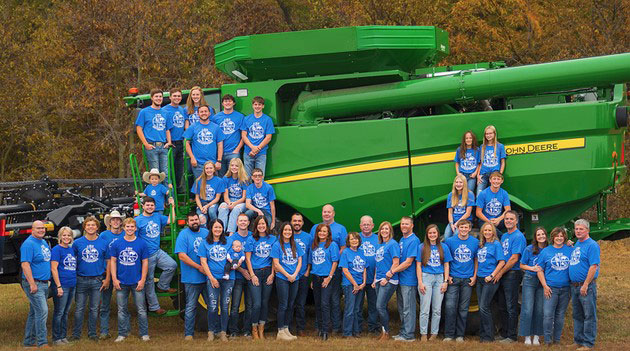
The Kramers often refer to G2 and G3, meaning the second and third generations of the family. Generation G2 is managing the company today and generation G3 is coming up.
Today, J-Six Enterprises employs around 700 people working on farms, livestock operations, trucking, and milling operations throughout Kansas, Missouri, Iowa, and Nebraska. J-Six Enterprises offers pet treat manufacturing, contract packaging, rail transloading, contract extrusion, dry corn milling, ingredient testing, and other grain storage and processing services in addition to the company’s farming and ranching operations.
Hog production is still a major element of the Kramer family operations. J-Six Farms and Livestock is described as a family farm with a worldwide reach.
It’s an impressive record of growth for John Kramer who came from the rural community of Corning, population 212 people. Now, that’s rural.
How does a person succeed in agriculture during challenging times? In the book, John Kramer credits mental toughness. In another part of the book, a writer points out that Kramer’s priorities are legacy and people. He is wanting to build a legacy for his children and grandchildren with benefit to others.
“We like providing jobs for people who want to move back to northeast Kansas,” Joe Kramer said. “We’ve provided opportunities for a number of people who have gone to the cities for jobs and wanted to come back to smaller communities to raise their families.”
For more information, see www.jsixenterprises.com.
In 1971, John Kramer moved back to rural Kansas with 30 hogs and a plan to build a business for his family. That plan developed over time. Today, J-Six Enterprises is one of the largest family-owned ag businesses in America.
We commend John and Janie Kramer and family for making a difference with visionary entrepreneurship in agriculture. It’s impressive that it all began with 30 pigs and a plan.
Audio and text files of Kansas Profiles are available at www.huckboydinstitute.org/kansas-profiles. For more information about the Huck Boyd Institute, interested persons can visit www.huckboydinstitute.org.
***