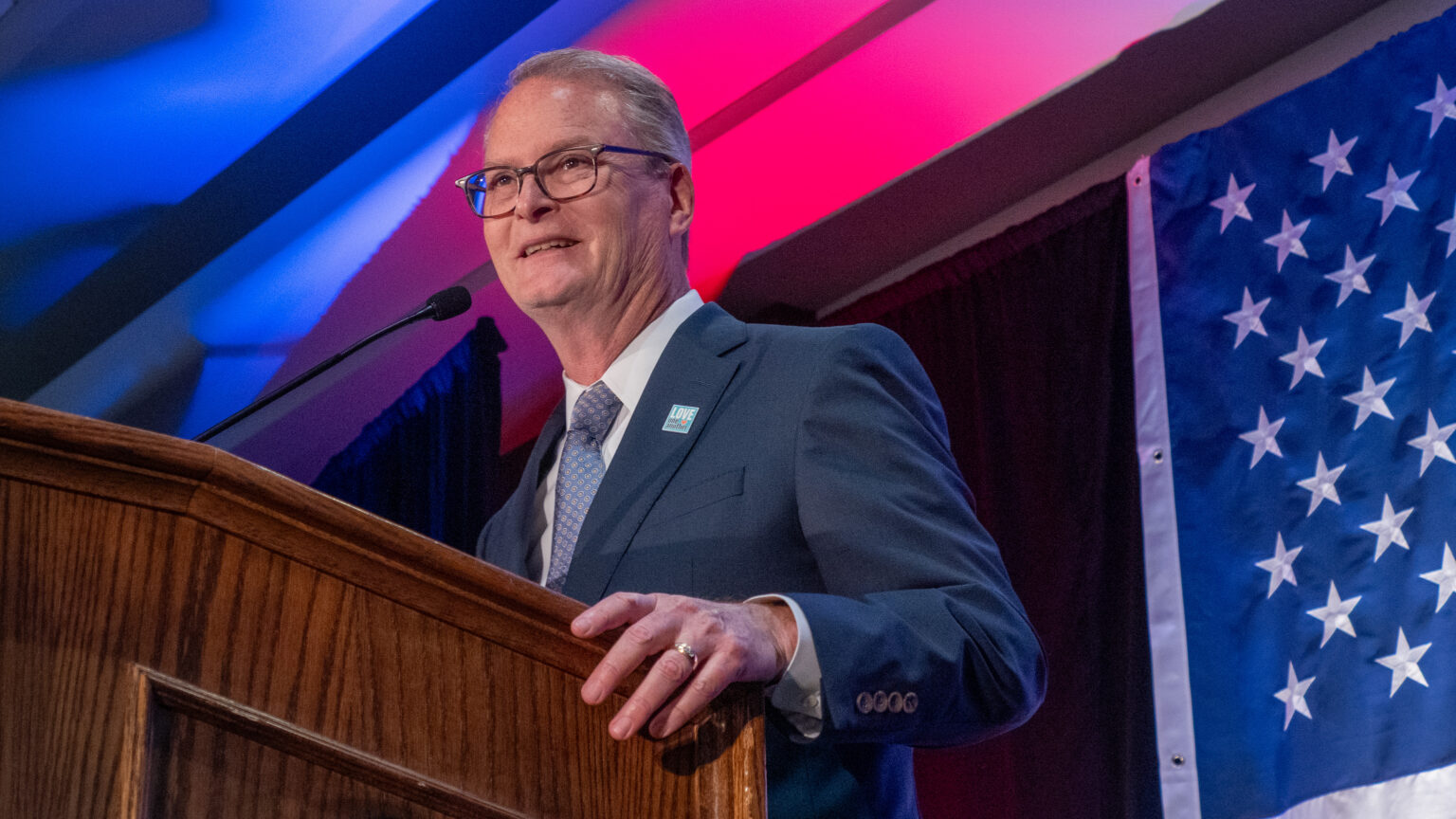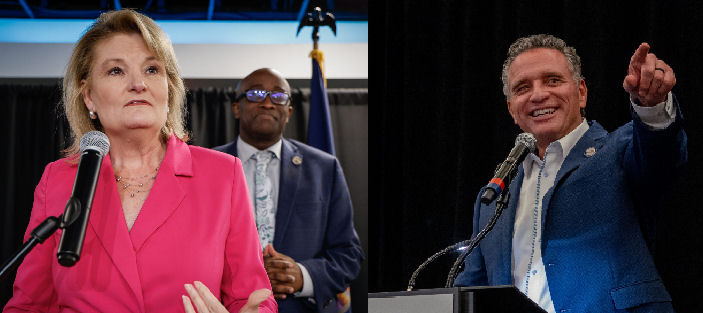
Democrat Cindy Holscher and Republican Ty Masterson battled to an unofficial draw Tuesday in the Kansas governor’s race, leaving anxious voters without a resolution in the high-stakes battle to determine who follows departing Democratic Gov. Laura Kelly.
Preliminary results mirrored campaign polling that suggested the outcome would be tight. The latest numbers issued shortly after midnight by the Kansas Secretary of State’s Office had Holscher with 546,523 votes for 50.3% of the total. Out of 1.08 million votes cast in the race, Masterson held 540,651 votes, or 49.7%. There were two remaining precincts to be counted, along with provisional ballots and mail ballots that arrive by Friday.
Holscher told supporters in Johnson County that she was confident that she would win the election when all ballots were finally tabulated.
“There are just a few more votes that need to be counted, but we are confident that once all the votes are counted, we will win,” Holscher said.
“We knocked on doors in every corner of this state. We made the calls. We showed up, no matter the weather or the circumstances. And because of you, we feel really, really good about where we are right now,” she added.
In Wichita, Masterson told a crowd of GOP supporters the contest was too close to call. He pulled the plug on festivities at a downtown hotel, but indicated he might come out on top if he landed 55% of the outstanding vote.
“Oh, man,” Masterson said. “It’s just way to close to call. I just wanted to close this down tonight because there’s obviously not going to be either a concession speech or a victory speech. What I’m afraid is we’re gonna have lawyers involved in this thing.”
Masterson, the Andover Republican and president of the Kansas Senate, didn’t break away from Holscher despite President Donald Trump’s personal intervention at pep rallies to drive MAGA loyalists to the ballot box. Masterson easily won the won the GOP nomination in August after Trump anointed his candidacy.
Masterson counted on the massive voter registration advantage among Kansas Republicans to propel his candidacy. With Trump’s approval rating in retreat and affordability the defining principle of the midterm campaign, it appeared conservative GOP enthusiasm faltered as stakes in the race inspired a surge in interest among Democratic voters. That left the outcome in doubt.
Holscher, an Overland Park state senator who didn’t initially receive the endorsement from Kelly, said the goal was to parlay voter outrage about the escalating cost of everything from ground beef to diesel fuel to claim a come-from-behind victory. In the primary, Kelly endorsed state Sen. Ethan Corson. After Holscher won the primary, Kelly pivoted to endorse the Johnson County Democrat.
At midnight, Holscher had yet to celebrate triumph or acknowledge defeat at her headquarters in Johnson County.
“I’m going to lower property taxes and bring down the cost of living for Kansans,” Holscher said in a preelection rally. “I’m going to fully fund our schools. That’s how every kid gets the same shot I had. I’m going to protect our seniors, stand up for our farmers. I’m going to expand Medicaid.”
“I want to work to make college more affordable, because students shouldn’t be graduating with a mountain of debt. I’ll work to legalize cannabis, because that’s what Kansans support,” she said.
For more than 50 years, Kansas voters elected governors from the political party opposite that of their immediate predecessors. In this instance, Masterson’s election would continue that history. The pivoting between Republican and Democratic governors could be broken if Holscher was elected to follow Kelly, the two-term Democrat.
Kelly grappled throughout her governorship with a Republican-dominated Legislature, and Holscher would have to do the same. House Democrats have sought to dispatch enough Republicans to erase the GOP’s two-thirds majority in that chamber. The Kansas Senate won’t be up for reelection until 2028.
The election of Holscher would break an extraordinary drought in Kansas elective politics. Her lieutenant governor running mate, Rep. KC Ohaebosim of Wichita, became the first Black person elected to statewide office since 1884.
Former Democratic Lt. Gov. Lynn Rogers, Holscher’s campaign treasurer, said Kansas Republicans underestimated how effective Holscher would be as a statewide candidate. There was a belief among some Kansas GOP operatives that Holscher’s failure to secure Kelly’s endorsement in the primary campaign would drag down her general election effort, he said.
Kelly did endorse Holscher after she defeated the governor’s preferred candidate, state Sen. Ethan Corson of Johnson County.
“I think the Republicans said she was the weaker candidate coming out because she didn’t have the original endorsement,” he said Tuesday from Holscher’s watch party.
He said the Holscher campaign reached out to young people and to voters concerned about the future of abortion rights, public schools. The campaign emphasized Masterson’s association with former Gov. Sam Brownback and passage in 2012 of huge income tax cuts that cratered the state budget, he said.
“We really tried hard with our younger voters because we knew how key that was,” Rogers said. “And, particularly young women voters because they knew that, again, if Masterson was elected, we’d go backwards on both of the constitutional amendments (on abortion) that we overwhelmingly rejected, and I think that was a big, big difference. We had to remind the younger people what Brownback did to our schools and our roads.”
_ _ _
Story via Kansas Reflector