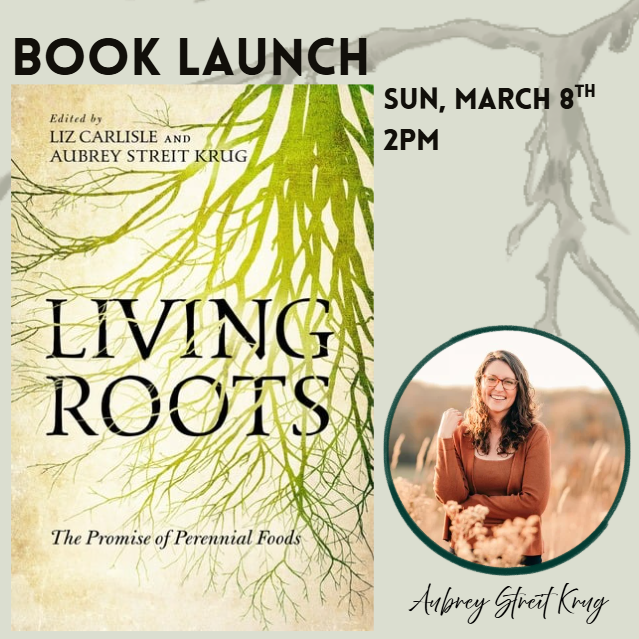
All are invited to a celebration of perennial foods and their deep roots in this community.
Red Fern Booksellers is planning a gathering to enjoy perennial treats and engage in conversation with scientists from The Land Institute who contributed to the new book “Living Roots: The Promise of Perennial Foods”. Aubrey Streit Krug, co-editor of the book, will introduce and moderate the conversation. Copies of the book will be available for purchase. The event will be this Sunday at 2:00 at the bookstore in Downtown Salina.
According to the bookstore, “Living Roots” makes the case for putting perennial foods at the center of our farms and our plates, to add flavor and nutrients to our diets while reducing emissions and making our food system more resilient to climate change and economic uncertainty. With contributions from James Beard Award-winning chefs, Macarthur genius grant-winning scientists, and a host of farmers who are leading the way on perennializing agriculture, the book takes readers on a behind-the-scenes tour of the largest food forest in the United States, the test plots developing the first commercial perennial grains, and the vast grasslands where Indigenous communities are returning bison to their prairie homelands. In the process, each contributor shares their unique story of learning with these long-lived plants about how to root deeper in the face of existential challenges, speaking directly to readers charting their own path on a rapidly changing planet.
Aubrey Streit Krug is a writer and researcher who investigates relationships among humans, plants, and places. She is the Director of the Perennial Cultures Lab at The Land Institute, where her team leads social and cultural research and educational efforts like civic science that feature learning with communities to help realize more just, diverse, and perennial grain agricultures. Her most recent project, co-edited with Liz Carlisle, is the essay collection “Living Roots: The Promise of Perennial Foods”. Aubrey grew up in rural Kansas, and her curiosity about grassland stories and plants led her to earn a PhD in English and Great Plains Studies.
About the other contributors:
- Tim Crews is the chief scientist and director of the International Initiative of the Land Institute in Salina, Kansas. He is currently working to invite and help support researchers from around the world to join in a global expansion of perennial grains development, cropping systems, and social adoption. He loves exploring the night sky, playing and listening to music, hiking, biking, and managing a prairie restoration cemetery with his wife, Sarah.
- Lee DeHaan has been leading efforts to develop perennial grains at The Land Institute since 2001. He has worked with a number of perennial grain candidates, but since 2010 he has focused on the domestication of intermediate wheatgrass, to be sold as the perennial grain Kernza®. DeHaan has MS and PhD degrees from the University of Minnesota, where his studies included agroecology, agronomy, and plant breeding.
- Muhammet Şakiroğlu is the director of natural science research at The Land Institute. Born in Eastern Turkiye, he earned his BS in biology at Harran University and was awarded the National Education Scholarship of Turkey for graduate work in the United States. He holds an MS from Iowa State University and a PhD from the University of Georgia, both in plant breeding and genetics.
- Laura van der Pol is a Homo sapiens mom dwelling on a former prairie in North America with her wife, child, and canine companion. She works as the lead soil ecologist at the Land Institute, where she studies interactions between perennial grain crops and soils. She earned her PhD at Colorado State University.
- David Van Tassel fell in love with green creatures at an early age and is happy looking at or trying to cultivate almost any of them, from pond algae and moss to houseplants, bamboo, and crops. By training he is a botanist and cell and molecular biologist with a PhD from the University of California, Davis. As The Land Institute’s lead scientist for perennial oilseeds, he learns how to grow, manage, and breed silflower.