Sexual assault victims of a former Manhattan chiropractor found guilty of dozens of crimes convinced the Kansas Senate Judiciary Committee to support reform of state law to require revocation of bond for people convicted of a serious offense.
Impetus for introduction of Senate Bill 358 and a hearing Wednesday on that bill before the Senate committee was the decision last year by Riley County District Judge Grant Bannister to release on bond Clark Petersen after a jury convicted him of 51 charges of rape, aggravated sexual battery, sexual battery and related offenses perpetrated against clients in his chiropractor office.
Petersen, who faced decades in state prison, was allowed to remain free until the jury convened the next day to consider a procedural issue. Petersen’s bond was revoked after the jury concluded he committed the crimes under aggravating circumstances. The jury’s decision enabled the judge to impose elevated sentences. In the end, Petersen was ordered to serve 32 years behind bars.
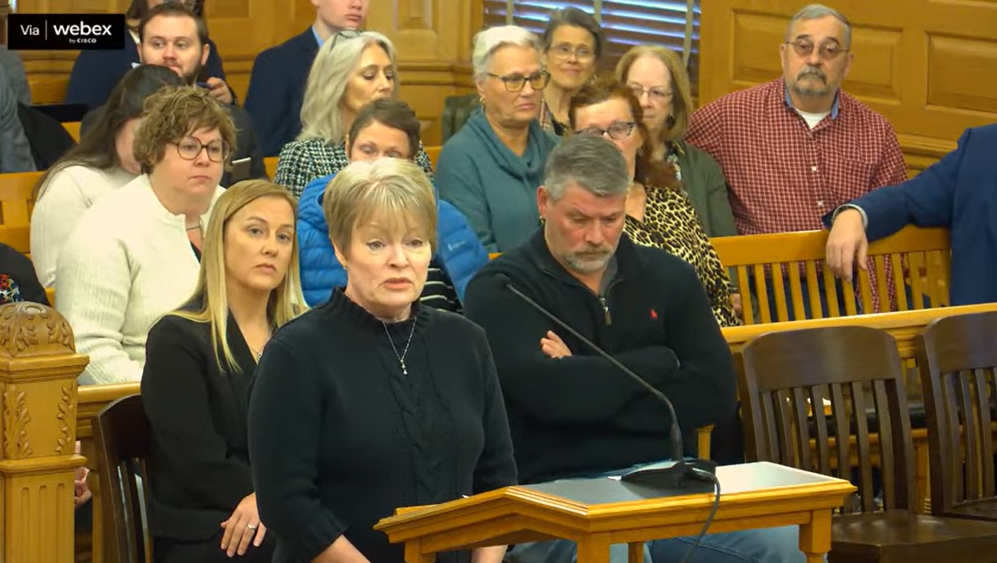
Elizabeth Jankord, who testified against Petersen at the assault trial in Riley County, told state senators it was difficult to describe the emotion that came over her when the jury foreman read the word “guilty” over and over. She said it was jarring to Petersen’s victims when the judge moments later said the defendant wouldn’t be immediately escorted to county jail pending sentencing.
“Essentially, allowing him one more opportunity to commit the crimes he had just been convicted of 51 times,” Jankord said.
She said the judge’s decision placed assault victims, members of the jury and officers of the court at risk if Petersen sought revenge.
Reform idea
Women harmed by Petersen attended the Senate committee hearing in a room at the Capitol previously used by the Kansas Supreme Court. One-by-one they asked lawmakers to approve SB 358. They requested the state require Kansas judges to revoke the bond of defendants convicted of high-level crimes carrying presumptive prison time.
Instead of allowing people to remain free after conviction, they said, individuals covered by the proposed statute would be held at a county jail until sentencing.
Under current Kansas law, a district court judge had the option of ordering post-conviction release before sentencing if reasonably assured the person wouldn’t flee or pose a danger to the community. Existing law was designed so judges could consider each case independently, including issues of a defendant’s plea agreement with prosecutors or the filing of notices of appeal.
Denise Wyrick, a retired marriage and family therapist who was treated by Petersen for 24 years, wept during her remarks to the Senate committee.
“Knowing that after Clark Petersen was convicted by a jury, the decision to allow him to remain on bond and return home overnight before sentencing was devastating,” she said. “Allowing someone convicted of serious crimes to remain free after conviction sends a dangerous message to victims, survivors and our communities.”
Judicial discretion
In terms of written testimony submitted to the committee, 18 argued in support of the legislation. It was endorsed by Republican and Democratic legislators as well as Riley County Attorney Barry Wilkerson. One individual shared criticism of the bill.
Grace Tran, a criminal defense attorney, said the bill would unwisely strip discretion from Kansas judges.
“I believe that these kinds of blanket policies are not good policymaking,” Tran said. “While this bill applies to crimes that carry presumptive prison sentences, that doesn’t always mean someone convicted of those crimes will go to prison. For instance, a person could enter into a plea agreement to plead to one of these crimes if the prosecutor agrees to recommend a dispositional departure to probation. In that case, it may not make sense for the defendant to have to go to jail pending sentencing.”
Tran said the bill didn’t take into account a defendant who remained free on bond without incident before trial or the defendant who required time to place personal affairs in order before incarceration.
In the Petersen case, the chiropractor was arrested in 2023 for alleged offenses against women that investigators said occurred at his business office between 2018 to 2022. He was released on $300,000 bond. He was charged with more than 60 offenses associated with 19 victims. He was found guilty by a jury on 51 charges. In 2025, he was sentenced to 32 years in custody of the Kansas Department of Corrections.
Sen. Kellie Warren, a Leawood Republican and chair of the committee, expressed gratitude to women who came forward to speak about their experiences and to advocate for changing state law to block individuals convicted of serious felonies from remaining free on bond until sentencing.
_ _ _
Story via Kansas Reflector
Photo: Elizabeth Jankord, who testified at the sexual assault trial of former Manhattan chiropractor Clark Petersen, says Kansas needs to change state law to deny bond to defendants convicted of serious felony crimes. She supports a Kansas Senate bill requiring these perpetrators to be held in county jail pending sentencing. (Kansas Reflector screen capture of Kansas Legislature video)