From its humble beginnings as a crucial U.S. Air Force base that supported victory in World War II to a one-of-a-kind destination campus in the heart of the Sunflower State, Kansas State University Salina has continuously evolved.
But throughout those decades, K-State Salina has always been at the forefront of innovative education, and 2025 marks the campus’ 60th anniversary of providing high-quality, niche degrees and programs that support all learners in the industries of aerospace and technology.
To celebrate, K-State Salina is inviting students, faculty, staff, alumni and the Salina-area community to its 60th anniversary celebration on Thursday, October 9.
The event will be 5 to 7 p.m. at the Salina Selfie Station, 111 S. Santa Fe Ave. Willie the Wildcat will be on hand to welcome and snap photos with attendees.
Air force base turns into cutting-edge aviation, technology institute
The grounds of K-State Salina opened for operation in 1942 during the height of World War II, originally built as the Smoky Hill Army Airfield for processing and a staging area of equipment before transitioning to what was known as Schilling Air Force Base in the 1950s.
Nearly 25 years after the base opened, it was deactivated in the mid 1960s. The land and much of the infrastructure has shifted for use by the Salina Regional Airport and educational facilities.
In 1965, Schilling Institute was established on the same grounds as the former air force base. The school quickly established itself as a leading post-secondary institution for aviation and technology programs, as well as the state’s only technical institute offering two-year programs of science and engineering technology.
The college offered degrees in mechanical engineering technology, electronics engineering technology, civil engineering technology and aeronautical technology. In 1967, the campus established its computer science technology department, representing the first computer science degree to be offered by any college or university in the state of Kansas.
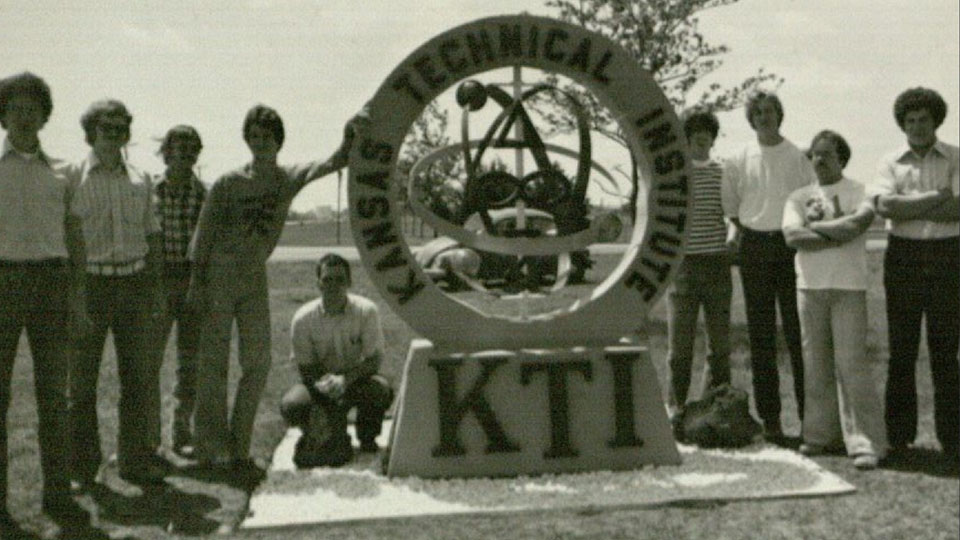
By 1969, the campus was renamed to the Kansas Technology Institute, still retaining its heavy focus for developing aviation and technology-related associate degrees, and in 1986, began offering the renowned professional pilot bachelor’s degree, a degree that is offered to this date at K-State Salina.
In 1988, the campus was renamed to Kansas College of Technology.
Becoming a K-State campus
In 1991, in a landmark decision, the campus community voted to merge into Kansas State University’s structure. At that time, the campus was known for its expertise in emerging technologies and a successful aviation program.
Since then, K-State Salina has continued to grow in its reputation for dedication to innovation. It was the first in Kansas to offer a computer science program, established one of the nation’s premier professional pilot programs and later made history supporting the Virgin Atlantic Global Flyer mission in 2005. With the launch of the Uncrewed Aircraft Systems program in 2008, the campus positioned itself as a national leader in drone education, research and application, offering one of the first bachelor’s degrees of its kind in the nation.
More recently, the campus has partnered with Hollywood entertainment company Pure Imagination to create a unique industry-academic model that goes beyond collaboration. As part of the partnership and an overall $41 million investment, K-State Salina is building the Kansas Artificial Intelligence Research and Entertainment Studio, or K-AIRES. This new 47,500-square-foot facility will be home to the latest emerging technology achievements of this time, and will have research, education and innovation in the in the industry of artificial intelligence, or AI, and virtual technologies.
K-State Salina remains committed to shaping the future of aerospace and technology. The campus is transforming bold ideas into impactful progress.
Through powerful industry partnerships and an education model that meets learners wherever they are, K-State Salina delivers unmatched opportunities that prepare the next generation of innovators and leaders.