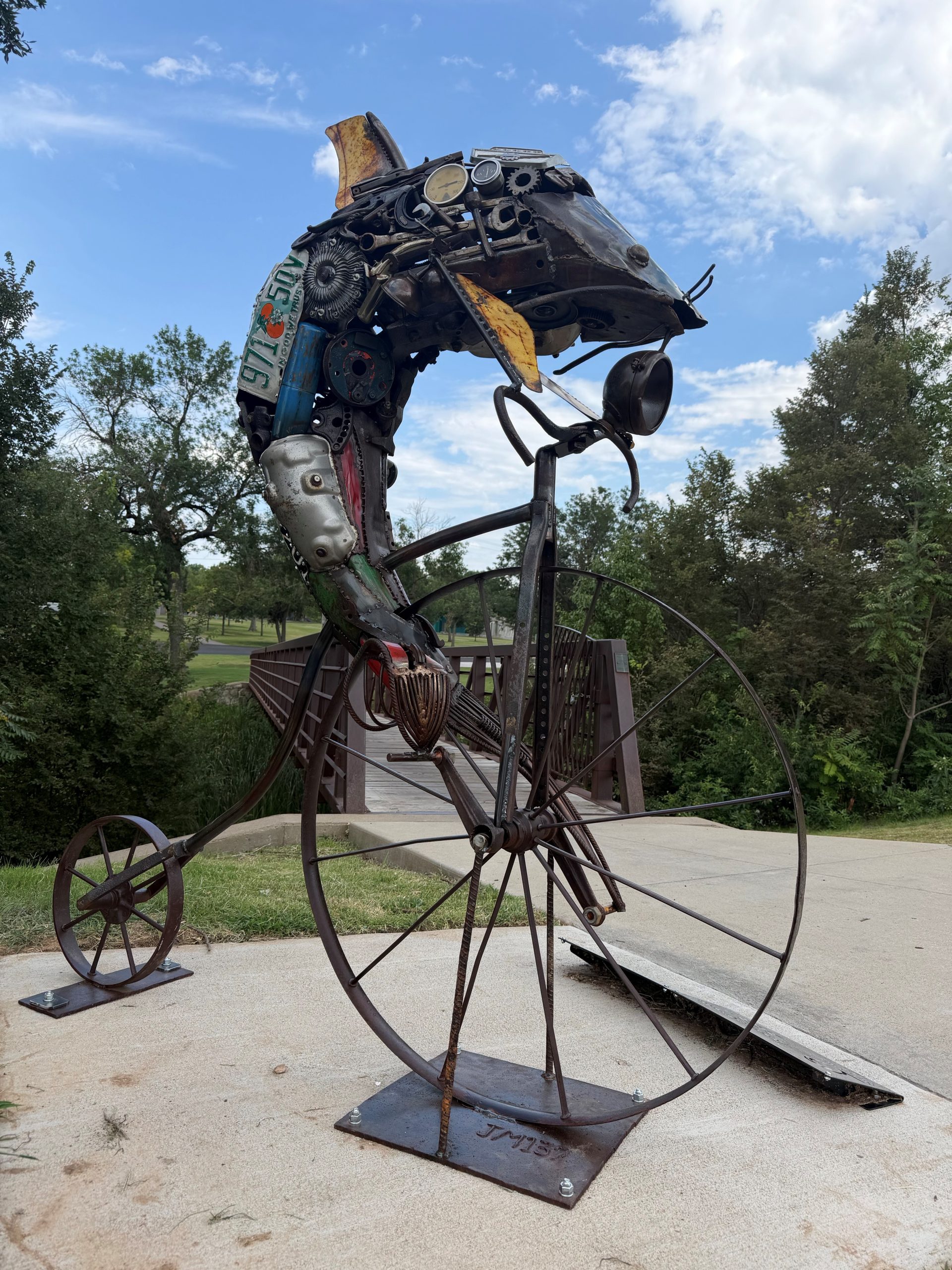
Joe and Terry Malesky gave Salina a story. This is not the kind of story that can be easily found by opening a book, watching a film, or perusing social media. It’s a story presented via the metal body of a catfish riding a bicycle, but if the time is taken to tease out the layers of this sculpture, a story emerges that spans decades, involves people from multiple communities, and demonstrates the ability of art to forge human connection.
The climax of a story is a turning point; a moment often infused with tension, drama, and intensity. It makes sense to start this story at the climax. The turning point starts on the night of June 8, when the ferocious winds of a tempest walloped Salina with a blow that won’t soon be forgotten. One of the many casualties from the storm was Clarence, or rather, the sculpture “Clarence the Catfish,” which won the 2022 People’s Choice Award for Sculpture Tour Salina. As the sun rose and our community began to emerge, dazed, bewildered, and growing devastated by the sheer scope of the damage, a City of Salina employee found Clarence crumpled and collapsed, and this is where the story truly crackles to life. The sculpture had been installed at his permanent home by the water treatment plant, near the Oakdale Park pedestrian bridge.
Members of Salina’s Parks and Recreation Department installed the piece, and as Adam Breault, a parks employee notes, the piece receives “endless compliments,” from the public, so it was important for many involved to get “Clarence” back to his place of honor greeting Oakdale Park patrons.
Knowing that Clarence had been “hugely embraced by the community,” Crystal Hammerschmidt, Arts Services Coordinator with
Salina Arts and Humanities, immediately contacted the creators of “Clarence the Catfish,” Joe and Terry Malesky.
“We wanted to get him fixed,” Hammerschmidt said. “The community is attached. And the story behind it is wonderful.”
The story Hammerschmidt is referencing is one of several that makes “Clarence the Catfish,” such a compelling piece. The sculpture was created using found objects crafted and welded into the shape of a quirky catfish riding a penny farthing bicycle. A sampling of these objects includes: a license plate from Florida, engine parts, various wrenches, a compass, gauges from myriad vehicles, scrap metal, tools, and parts of a farm implement that became the sculpture’s base.
The name Clarence is a nod to Terry Malesky’s grandfather, who taught Terry and Joe to catfish. The playful name came to the piece later, as the Maleskys, a married couple who sculpt together, let these indiscriminate objects serve as a creative springboard for their work. Once presented with an object that sparks imagination, a sculpture is soon to follow. In Clarence’s case, when they were given the farm implement that became the base, Joe knew they were going to make a penny farthing bike, but inspiration struck, allowing him to take the piece farther.
“I thought, ‘Oh! I’ll make a catfish to ride it,’” Joe said. Naturally.
It helps to know the Maleskys. They are a rare duo who may be impossible to dislike. They are spry, energetic, and radiate kindness. Joe is tall, lean, and has eyes that crinkle in the corners when he smiles—which is often. Terry is short, trim, and has a longish fringe of bangs that frame her face. Joe retired in 2013 from years of self-described blue-collar work; over the course of his career, he was employed as a machinist and steel fabricator. After Terry retired in 2018, they began creating in earnest, searching scrapyards for items to repurpose with Joe’s welding torch. Like their “Clarence” sculpture, the Stafford, Missouri residing couple have a shared presence that is brings an easy smile. Joe is avuncular, open in a way that puts others immediately at ease, and as revealed through his art, he has a playful, ornery streak. Terry is articulate, encouraging in a way that makes others comfortable, and as revealed through her art, she has a playful, ornery streak.
They love to discuss art and do so with the confidence of people comfortable existing within the creative world, but according to Joe, it took some encouragement to arrive at this place. He admits that he “didn’t know he was an artist,” until a chance meeting at a flea market changed his life.
“Emmett Kelly—the famous clown—his grandson saw some of my sculptures, and gave me a long talk about how what I was creating was art and that it should be in museums,” Joe said. He didn’t have formal art training and didn’t consider his creations to be on par with others whose work he admired.
“Artists—we’re our own worst critics,” Joe admits. “So, people will tell themselves they aren’t artists.”
That encounter stuck with Joe and eventually, he found the confidence to enter his first gallery show, where he was voted Best in Show by 28 of his peers.
“When I got that affirmation from my peers, that’s when I felt like I was an artist,” he remembers.
With time, the Malesky’s work has garnered recognition and they have built a steady presence in the art world. It’s easy to see why their art is embraced: like “Clarence the Catfish,” much of their work is amusing, playful, and has universal appeal.
“There is a lot to look at,” Hammerschmidt said in reference to Clarence. “You don’t have to know the technical skills involved in creating that work and you don’t always have lofty conceptual idea. We know a catfish. We know a bicycle. There is no barrier to what we (the viewer) appreciate. It’s familiar.”
This familiarity evokes a sense of nostalgia for many who grew up in the Midwest, where summers were filled with fishing, exploring rivers and streams, and embarking upon outdoor adventures that occur when bicycles are the primary mode of transportation and the limits of these epic escapades is directly correlated to the likelihood of parents discovering the nature and danger of these quests. This universal appeal is important to the Maleskys.
“If you are a little kid to 100 years-old, you can look at (Clarence’s) parts and identify something,” said Joe. “If you’ve taken the time to ID something, then you’ve identified with the sculpture itself.”
This ease of connection with the sculpture is likely what helped it become a local favorite. After the storm, Clarence, lying beached on his side, bike wheel crumpled and twisted like the ungainly roots of a dying juniper bush, seemed to visually symbolize the sense of broken despair and low moral felt by so many community members.
“I was really bummed when I saw he had been damaged,” said local mother Jessica Haywood. Because she lives near downtown, Haywood said that she and her children have enjoyed seeing Clarence on their walks. Haywood’s two and a half year-old son Josiah found the sculpture particularly delightful, often exclaiming, “Bike! Fish!” upon seeing the beloved piece. “Seeing his excitement is great,” she said.
The multigeneration connection and forming memories and stories related to art is important to the Maleskys. Not only is the name “Clarence,” a nod to Joe’s grandfather, but a bit of his father is embodied in the sculpture as well. On Clarence’s right side, near where a gill or fin might be on a live fish, is an unassuming oil can. In the chaos of the other items, the oil can could easily be missed. The oil can was always on his father’s work bench and it was eventually passed down to Joe. He used it for years until it sprung a leak, so he “found another use for it.”
The Maleskys were happy to repair the sculpture and they even got a Kansas antique license plate donated from Adam Breault that was used to fill a broken spot near the base of the sculpture.
“It was one of my dad’s,” said Breault. “I knew there was a Florida plate and I thought it would be a nice addition to Clarence. The bottom of the plate says ‘the wheat state.’”
This story resolves itself in the most uplifting manner and one that reveals how art has the power to forge myriad connections. The Maleskys gave the Salina community much more than just a sculpture. Joe gave Salina a small piece of his heart in the form of his father’s oil can. In turn, Adam Breault also added a piece of his heart and family to “Clarence the Catfish.” Through his rusted metal body and delightfully dour catfish expression, Clarence the Catfish serves to remind us of the best parts of humanity.
“I think that art reveals life,” said Brad Anderson Executive Director of Salina Arts and Humanities. “It reveals the humanity in each other and it makes us better for having it.”
Through this personified piece we are reminded that connection matters, art has the power to contain multitudes of stories, and life should contain moments of pure joy.
_ _ _
The special feature was commissioned by Salina Arts & Humanities and written by Jessica Grant, an independent writer.
Clarence has been reinstalled near the corner of South Street and 4th Street, outside Oakdale Park in Salina, KS.