Long before he stepped onto a research field in western Kansas, Rayhaan Kabenge was building small systems in Kampala, Uganda, trying to understand how technology could make everyday work easier.
That early curiosity, shaped by a family that valued precision, discipline and service, eventually led him halfway across the world to Kansas State University, where he is now helping design advanced digital tools for farmers as a graduate research assistant with the Testing Ag Performance Solutions team.
Kabenge grew up as the oldest of three, raised by an engineer and a gynecologist who set high expectations in both academics and character.
Kampala’s diversity exposed him to a wide range of ideas, but he found himself drawn to engineering and problem-solving. During his undergraduate studies in water and irrigation engineering at Makerere University, he designed an innovative wireless irrigation control system.
The experience deepened his interest in developing technology that could improve farmers’ livelihoods.

A meeting that redirected his future
His path shifted in 2023, when Daran Rudnick, K-State director of sustainable irrigation and leader of KSU-TAPS, now his advisor, visited Makerere University.
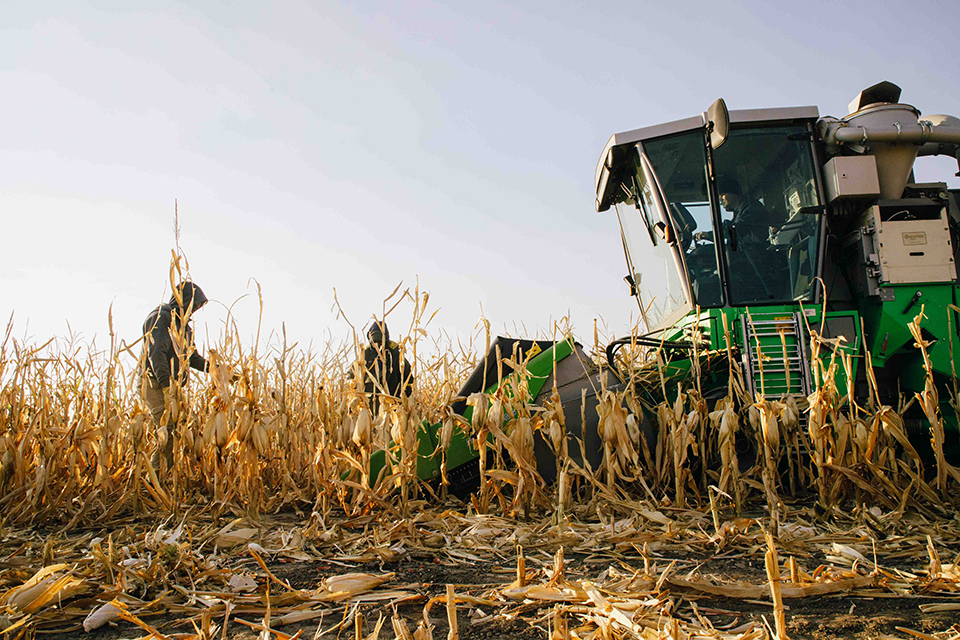
Rudnick described the hands-on agricultural research underway through TAPS, a model that blends scientific experimentation with real decisions made by farmers housed on the Kansas Agricultural Experiment Stations. The program draws on engineering, agronomy, sociology, economics and data science.
That interdisciplinary structure is part of what makes TAPS distinctive and effective, giving producers access to solutions shaped by multiple fields rather than a single discipline.
Kabenge recognized immediately that it was the kind of work he had been seeking. It was practical, applied and directly connected to producer needs. Rudnick later offered him an internship, and within months, Kabenge was in Kansas experiencing his first season of field trials, data collection and producer engagement.
“Seeing that level of engagement and practical learning was exciting,” Kabenge said. “It showed me how impactful research can be when producers are directly involved.”
Bringing data to life for farmers
Now a master’s student in the K-State Carl and Melinda Helwig Department of Biological and Agriculture, Kabenge is leading the development of a TAPS Decision Support Suite, a web-based dashboard designed to help producers interpret complex field data and make timely decisions.
The dashboard integrates weather data, soil moisture readings, irrigation and nitrogen logs, drone imagery and crop-health indices. Its distinguishing feature is an AI-powered interpretation tool that converts technical analytics into plain-language explanations.
Kabenge said the tool “bridges the gap between technical analysis and practical decision-making” by helping users understand what patterns mean and why they matter.
Working beside producers reshaped how he approaches engineering. Earlier in his academic journey, he began with technology and sought a way to apply it.
Now he works in reverse.
“I begin with producer needs and reverse-engineer the solution,” he said. “Understanding their challenges, habits and decision-making processes ensures that the tools we design are not just technically sound but genuinely useful.”
Adjusting to a new home and a new rhythm
Coming to Kansas required a steep learning curve. From research methods to climate to cultural norms, almost everything was different from what he knew in Uganda. He also spent long stretches driving between classes on campus at K-State in Manhattan and the Northwest Research-Extension Center in Colby for fieldwork, a route he jokes he could now navigate in his sleep, though he is quick to add that he never would.
Even with the adjustment, Kabenge found a sense of community within the TAPS program and the broader K-State Extension network.
“Any time I face a challenge, in class, in research or in coding, people are genuinely willing to help,” he said. “This level of openness and teamwork creates an environment where you feel supported.”
He was especially struck by how effectively a small team can run a program with such a significant footprint. Watching the TAPS team organize producer outreach, manage trials and maintain data integrity left a lasting impression.
“It honestly surprised me how such a relatively small team can run a program as large and impactful as TAPS,” he said.
Their collaboration has shaped his understanding of leadership and teamwork.
A global vision for agricultural innovation
That perspective also influences how he thinks about the future. Kabenge hopes the tools he is building at K-State will eventually support producers far beyond the High Plains.
“My goal is to create systems that help producers get more out of what they invest while prioritizing environmental sustainability,” he said.
Whether deployed in Kansas, Asia or Africa, he wants those tools to simplify decisions and improve efficiency.
Kabenge is encouraged by how quickly AI is advancing and what that progress could mean for producers. He sees a future in which farmers will not need deep technical expertise to make confident decisions because the tools will translate complexity for them.
The possibility of combining global data, shared knowledge and advanced models to support agriculture anywhere in the world is something he finds genuinely exciting.
For students, especially those from abroad, who want to pursue agricultural research, Kabenge encourages curiosity and a broader perspective on the field.
“Many students hear ‘agriculture’ and immediately think of soil, hoes and rakes, but there is so much more to it,” he said. “There are endless opportunities to innovate and solve real-world problems using engineering, data science, AI and automation. Come in with an open mind, be curious and don’t be afraid to chase bold ideas.”