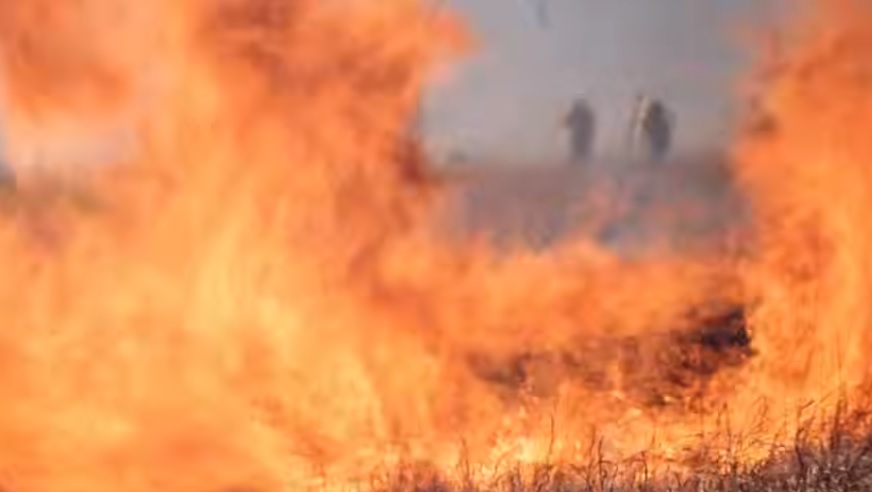
Every spring, ranchers and land managers across the Great Plains set prescribed fires to keep grasslands healthy.
Most of the time, the burns go as planned. But when they don’t, the results can be catastrophic and even deadly in the communities that call the Great Plains home.
Mayowa George, a doctoral student and researcher in the Carl and Melinda Helwig Department of Biological and Agricultural Engineering at Kansas State University, is working to minimize the number of uncontrolled fires by creating a tool that will help fire managers gain a better understanding of all the variables that could affect a burn.
His curiosity around fire started at home. When George was young, a major fire broke out in his community, resulting in the loss of lives and property.
“Seeing its devastating effect on families stayed with me and made me want to understand why fires become so destructive and how similar tragedies can be prevented,” George said.
A tool built for the Great Plains landscape
Deciding whether a given day is safe to burn is a high-stakes call. Many existing fire danger tools were designed for other regions, vegetation types or wildfire-management purposes, so they don’t always fit the grasslands of the Plains.
George is developing a localized Grasslands Fire Danger Index, or GFDI, tailored to the climate of the Great Plains, especially during the prescribed burning season. The index combines wind speed, temperature, grass curing, fuel moisture, and long-term drought indicators to estimate how readily a grass fire could spread and how hard it would be to control.
He also developed submodels for dead fuel moisture and grass curing, which serve as key components of the index.
Zifei Liu, George’s advisor and assistant professor in the Department of Biological and Agricultural Engineering, said George’s work ethic, persistence and growth as a researcher distinguish him.
The goal is to give land managers a clearer picture of fire danger when deciding whether conditions are suitable for a prescribed burn.
Leveraging local ranchers’, land managers’ insight
The GFDI is not a replacement for the ranchers and land managers who have been reading weather and grass conditions for generations.
Instead, the index complements and strengthens land manager knowledge. It does this by organizing measurements from weather stations, fuel-moisture models, and vegetation observations into information that managers can consider alongside their own experience.
Additionally, the index can help scientifically document patterns that experienced land managers already recognize, in turn making generational information accessible to newer land managers or individuals working in unfamiliar areas.
“The knowledge held by ranchers and land managers in the Great Plains is extremely valuable,” George said. “My goal is to develop a tool that works alongside land managers and supports their judgment, and when we can give them the data and insights needed to plan safer burns, we can reduce fire risk and improve overall safety.”
From agricultural engineering to fire science
George’s doctoral research builds on his background in agricultural engineering, which examines how environmental conditions and human decisions influence the management of natural resources.
He holds a Bachelor of Technology in agricultural engineering from Ladoke Akintola University of Technology in Nigeria and a master’s degree in biological and agricultural engineering from Kansas State University.
“Fire science is therefore a natural extension of my agricultural background,” George said. “This perspective helps me examine fire in the Great Plains as both a safety issue and an important part of grassland management.”
Recognized for advancing fire science
George’s research has earned him recognition from the International Association of Wildland Fire, which named him the sole doctoral recipient of its 2026 Graduate Student Scholarship. He is the first Kansas State University student to receive the honor.
Liu said the recognition reflects George’s development into an increasingly independent researcher.
“During George’s time at K-State, he has developed from a diligent student who primarily followed guidance into an increasingly independent researcher who takes initiative, identifies meaningful questions, and is building his own research direction,” Liu said.