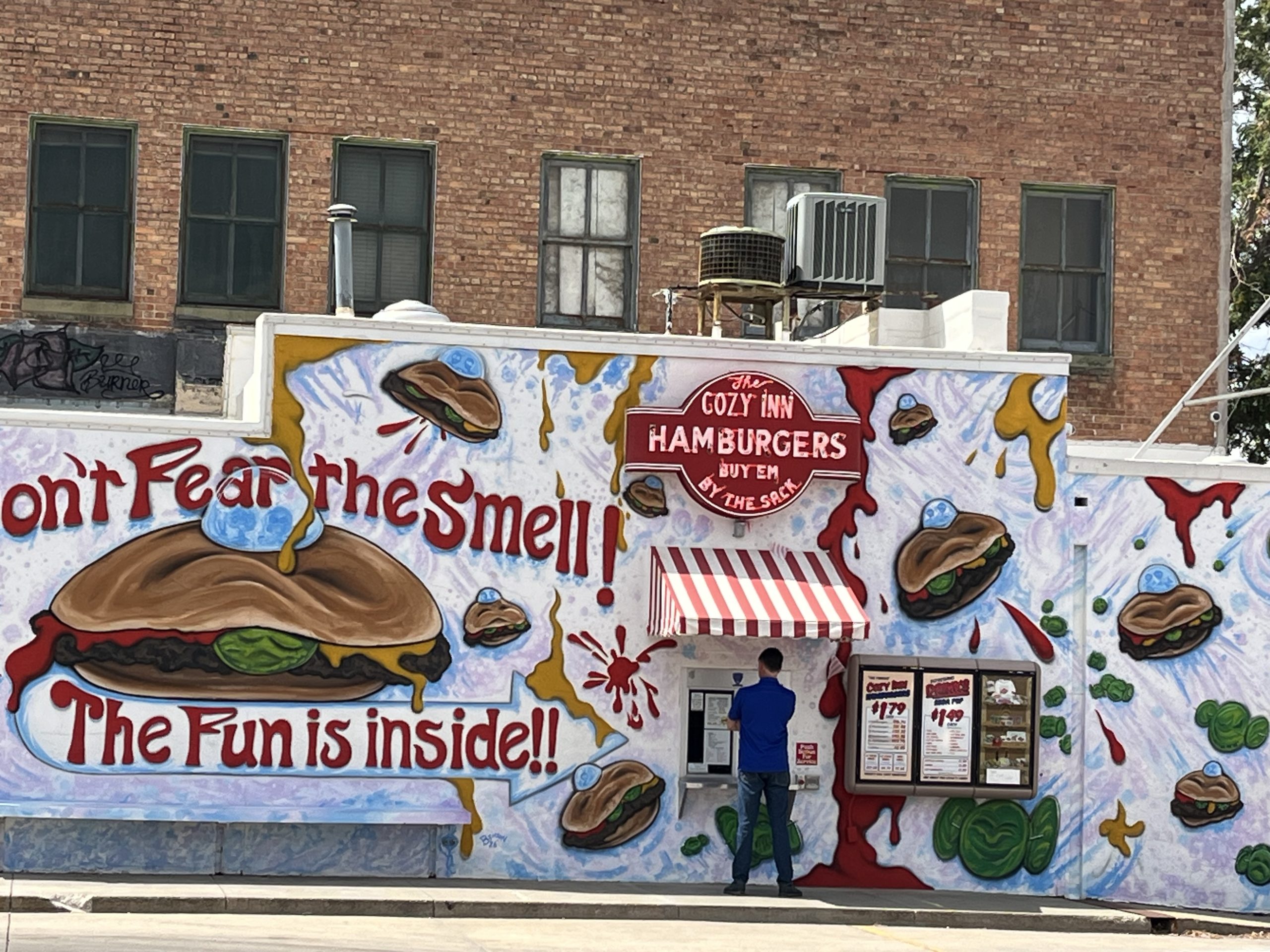
The lengthy legal fight over the Cozy Inn’s flying-saucer burger mural has reached its conclusion, following the ruling from the U.S. Court of Appeals for the Tenth Circuit. Now, the City of Salina preparing to overhaul its local sign code.
Sam MacRoberts, General Counsel and Litigation Director for the Kansas Justice Institute, joined the KSAL Morning News Extra Wednesday to reflect on the case, which centered on whether the city could stop Cozy Inn owner Steve Howard from painting the custom artwork on his own building.
“Cities in Kansas: quit playing art critic,” MacRoberts said, emphasizing that local governments cannot use arbitrary sign codes to restrict free speech or pick and choose which murals are allowed based on their content.
The dispute began in late 2023 when city officials ordered Howard to stop work on the UFO-themed mural on the side of his restaurant. Salina code enforcement claimed the artwork constituted an oversized commercial sign under local regulations rather than an unregulated mural, largely because it referenced the restaurant’s famous burgers.
The Kansas Justice Institute filed suit on Howard’s behalf in early 2024, alleging content-based discrimination under the First Amendment and an unconstitutional prior restraint on speech. Both a federal district judge in late 2025 and the Tenth Circuit Court of Appeals in late 2026 ruled in favor of Howard, holding that the city lacked credible evidence to show that product-focused murals posed any greater threat to aesthetics or safety than other unregulated murals across downtown Salina.
MacRoberts noted that the ruling carries broader implications across Kansas and the Tenth Circuit, sending a strong message about property rights and expressive freedoms. “This is Steve’s wall. It’s not the city’s wall,” MacRoberts said, pointing out that speech restrictions on private property require a far higher standard of evidence than basic time, place, and manner rules.
The litigation resulted in significant costs for the City of Salina, with total legal fees exceeding $800,000.
MacRoberts confirmed that the Kansas Justice Institute waived its right to seek attorney’s fees or financial damages from the city, reiterating that the goal of the lawsuit was strictly to protect the mural and uphold constitutional rights.
Salina officials have announced they will not pursue further legal action or seek Supreme Court review. Instead, city staff are now tasked with drafting amendments to the sign code to ensure equal treatment for exterior wall displays and align local ordinances with federal standards.