The Kansas State University College of Arts and Sciences faces a $2.6 million annual budget shortfall in addition to millions owed for loans from the administration, a situation that may eliminate academic programs and cause faculty layoffs.
K-State officials presented a plan to address $13.5 million the college owes to the school’s administration, as well as the projected annual shortfall, at a September town hall, the Collegian reported.
The reverberations from that meeting, where employees were told about likely layoffs and an assessment process that will occur to determine a reorganization plan, worried professors.
“The college has held two all-college meetings to discuss these challenges and has been transparent that potential options may include departmental mergers, discontinuation of academic programs and workforce reductions,” said an unattributed statement from K-State in response to Kansas Reflector questions. “No decisions have been made yet.”
The budget announcement came as state universities struggle to make up state funding shortfalls — some tied to requiring proof the universities eliminated diversity, equity and inclusion education. Fort Hays State University announced last month it was closing the Sternberg Museum of Natural History because of state budget cuts.
Ongoing budget issues
The College of Arts and Sciences budget problems aren’t new, said English professor Dan Hoyt.
“If we’re going to make these drastic budget cuts, healthy programs might be lost,” he said. “There is lots of talk from administration about us losing departments and maybe even the college, and forming schools. That will mean, though, fewer choices for students and less autonomy for programs, and it also will mean lots of job losses for staff.”
In university organizational structures, colleges are broader with multiple subjects while schools are smaller and more specialized.
Jesse Perez Mendez, K-State provost and executive vice president, announced a new organizational process at the town hall, which involves input from faculty. Hoyt and other professors said it will require significant time and paperwork from faculty.
Hoyt and Philip Nel, an English professor, said they are concerned about the speed with which the university is tackling the organizational process.
“The A and S budget has been in deficit for years, so it’s not actually news,” Nel said. “What is new is that it’s now being treated as if it’s a crisis. Arts and Sciences serves the entire university in terms of the courses that we teach, and it doesn’t bring in the same kind of grant money that perhaps other colleges do.”
Faculty in Arts and Sciences teach 40% of all the credit hours at the university, Hoyt said.
Nel, Hoyt and David DeFries, an associate history professor, all question the budgeting process used in the past and the assessment process being proposed.
“The budget model we were presented last year was built on assumptions that are hard to verify,” Nel said. “For example, it was built on the sustained increase of students at the time that we’re facing a demographic cliff. That’s a great narrative to promote, and even an aspiration to have, but it’s not something on which I would build the math of the budget.”
The “cliff” Nel referred to is the decrease of college-age students in the next decades because of lower birth rates.
The College of Arts and Sciences decreased freshman enrollment from 713 in fall 2025 to 624 in fall 2026, according to a university dashboard.
Nel said decisions are being made without consulting faculty.
“There is an attempt to move power away from the faculty into central administration in order to serve what I perceive as a different mission than the one that I signed up for,” Nel said. “I see a university as a public good that encourages people, students, faculty, to pursue truth wherever it may lead, and it may lead to disagreement.”
DeFries said the assessment process asks questions such as what can be done to bring more students into Arts and Sciences.
He offered an answer: “Not much.”
“I mean, they are the ones who have been engineering the curriculum and public relations to drive people away from our programs,” he said. “They’re the ones who have given the engineering school and the business school and the grain science all these shiny new buildings, and left the humanities and the College of Arts and Sciences in the old buildings that need renovation.”
A slide at the town hall shared with Kansas Reflector said one-third of the college’s 22 buildings need 50% of replacement value in deferred maintenance. The example given said if it would cost $10 million to replace the building, and $5 million was needed in maintenance.
Jean Folkerts is a retired professor, former interim dean of the K-State journalism school, and a member of the Kansas Press Association hall of fame. News of proposed cuts to the college’s budget didn’t surprise her because financial challenges were ongoing.
“For starters, Arts and Sciences has always been a stepchild at K-State,” she said. “It’s dominated by agriculture, business, architecture and engineering. Arts and Sciences has always existed as something that they never really, I think, put a lot of effort into.”
Folkerts said past budgeting processes weren’t appropriately designed for a college like Arts and Sciences that offered prerequisites that students in other colleges needed. In 2017-18, “big budget cuts” were needed and the school cut across the board without trying to reinforce strong programs, she said.
Other changes affected Arts and Sciences, such as students beginning to take prerequisite courses like Composition I and Speech at community colleges.
Folkerts would like to see K-State officials work through the assessment process of what’s next for Arts and Sciences by talking to former deans and associate deans to gather insights. Arts and Sciences is a “very large college,” which was challenging in many ways, and there could be ways to split it up effectively.
“My absolute clear statement that I want to make is: No university is a decent university if it does not have a strong college or collection of colleges of Arts and Sciences,” she said. “It’s an underpinning of the university.”
Looking long-term
K-State officials said the current process to address the budget will look at long-term strategies.
“The goal is not simply to resolve an immediate budget shortfall, but to build a sustainable foundation that protects the college’s academic strengths, supports student success and creates opportunities for future growth,” K-State’s statement said.
The Arts and Sciences Renewal Committee is the assessment process designed to “examine the college’s current structure, engage faculty and staff, explore potential organizational models, and develop recommendations for a path forward that enables the college to invest in its future,” the statement said.
An aggressive student recruitment campaign with student incentives is also planned.
The university statement said the debt to the administration was accrued after the university allowed the college to spend in excess of its allotted budget for the past three years to hire new faculty and additional adjunct instructors and pay other expenses.
That loan will be repaid in annual installments beginning in 2029 through 2043.
“Although the college is reimbursed for all student credit hours it teaches, during the three-year period, student credit hours continued to decline while related expenses were not reduced in accordance,” the statement said. “The college is now facing a structural deficit.”
Student worries
Lily Hansen is a sophomore majoring in English and social transformation, which she described as an umbrella term for gender and women’s studies and ethnic studies. Last year, she found out Arts and Sciences was discontinuing the social transformation degree, but those already enrolled are allowed to complete it, Hansen said.
“We’re having a lot of cuts in humanities-based fields,” she said, adding that students received little information about what was happening with the degree program and that same lack of communication is happening now.
Hansen, who began her college experience as a biology major, said she values STEM degrees, too, but believes there is an attack on humanities, which she called a focus on “anti-intellectualism.”
“As people in general, we’re devaluing thinking so much, with the rise of AI and all that,” she said. “It’s so frustrating to see these majors — their entire purpose is to teach you how to think, teach you the baseline of how to be a capable human being — face the most backlash.”
Higher ed challenges
DeFries, Hoyt and Nel all said what is happening at K-State is part of the controversial landscape occurring nationally in higher education, including disagreement on cultural issues.
“We encourage students to ask questions that will challenge dominant assumptions about gender, about race, about sexuality, about capitalism,” Nel said. “If you are working to dismantle or, excuse me, reorganize, the College of Arts and Sciences, you are also reorganizing the area of the university where critical thinking is key.
“It’s key everywhere but it’s particularly key in terms of how can we make our democracy work better? What would justice look like in America? How can we ensure that we act for the good of the many and not just the few? Questions that are ethical, that are moral, and that can guide us to one hope: build a better society, make the current one that we live in work better, and make people’s lives more fair, make people’s lives ones that have greater access to opportunity, and that is not the direction that either the university or the country is currently headed in.”
_ _ _
Story via Kansas Reflector
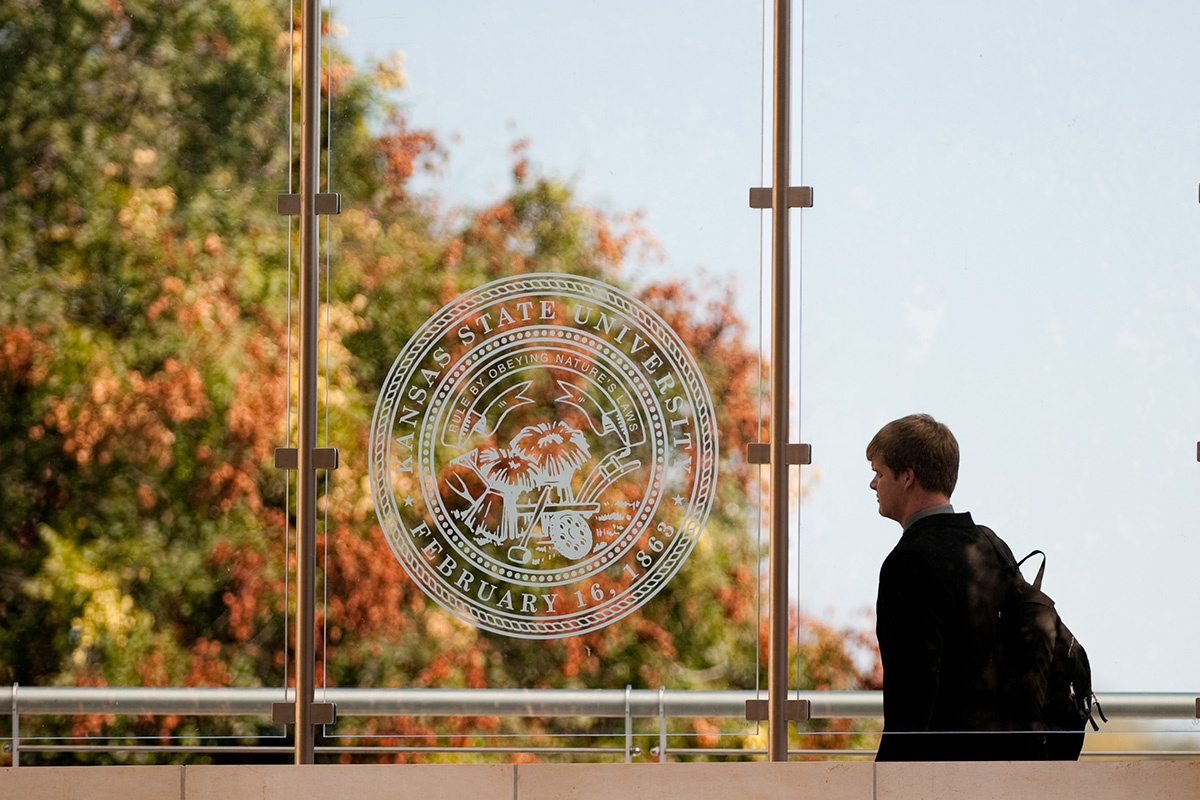
Photo by K-State Division of Communications and Marketing: Kansas State University College of Arts and Sciences is undergoing an assessment process to determine how to save money as its budget sits in the red, according to university officials.