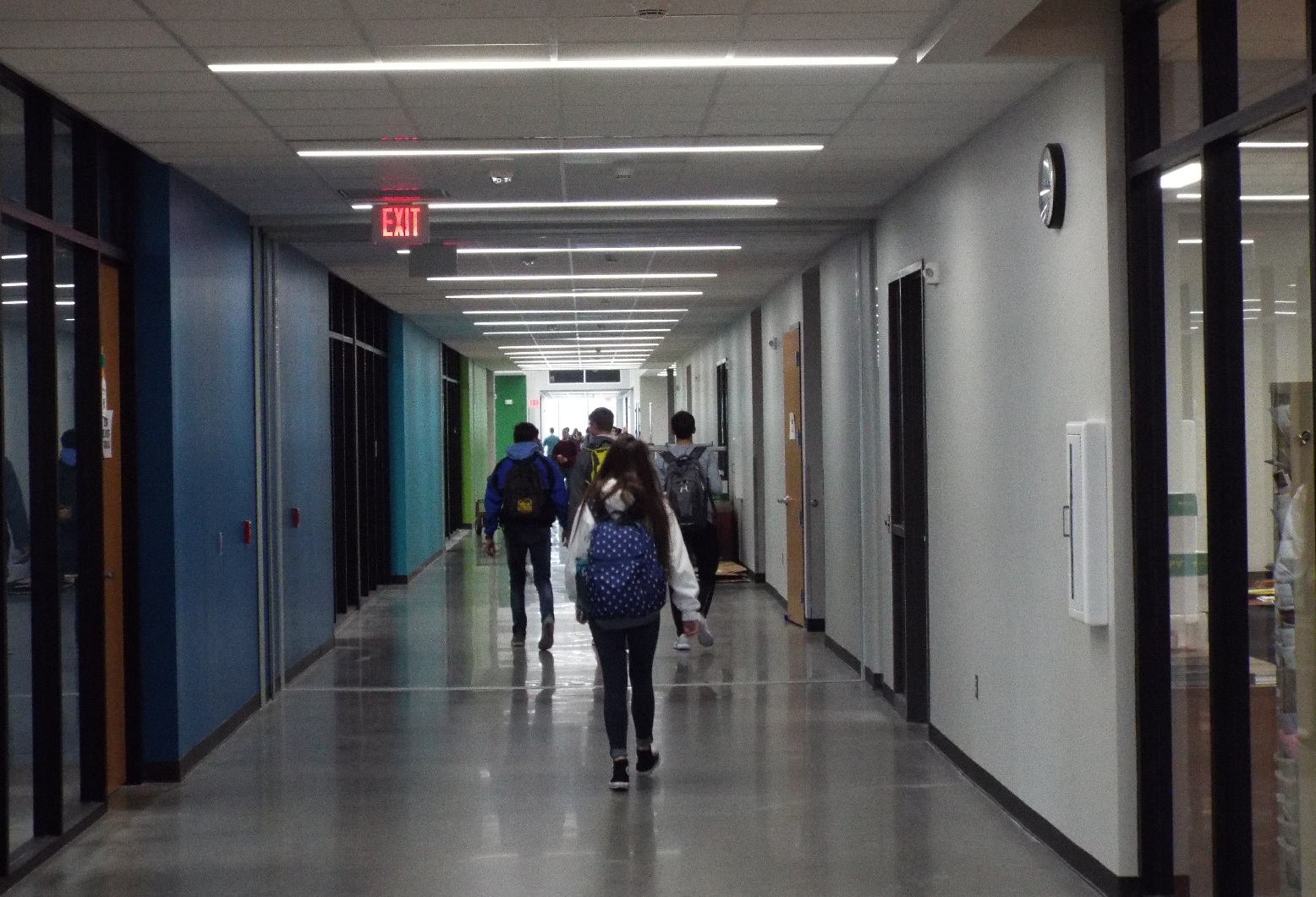
A bipartisan Kansas bill that aims to implement a bell-to-bell cellphone ban beginning next school year would override local rules and establish one of the nation’s most restrictive policies.
The bill already has garnered a two-thirds supermajority of support from the Kansas Senate, as well as the support of Democratic Gov. Laura Kelly.
Supporters of the bill say students would be mentally and physically safer, while opponents argue it’s an overreach of power that asks too much of students and schools.
More than 20 people testified on Senate Bill 302 on Thursday before the Senate Education Committee, including Timothy Graham from the Kansas National Education Association, which represents 22,000 educators.
“Our members are all over the place on this issue,” Graham said. “Understandably so.”
‘Problematic outcomes’
Ngoc Vuong, a school board member for Wichita Public Schools and a community psychology PhD candidate, told the committee he researches the academic effects of cellphones in schools.
“While multiple factors are responsible for causing and exacerbating the ongoing youth mental health, literacy, and numeracy crises, the evidence increasingly points to the advent and proliferation of a screen-based childhood, the immense power and influence of Big Tech companies over our society, culture, and education system, and the unhealthy relationships many children and adolescents have with smartphones and social media as central drivers of these problematic outcomes,” Vuong said.
In his written testimony, Vuong linked cellphone use to poor academic performance, attention, executive functioning, sleep, and physical and mental health.
Gretchen Shanahan, a parent from Overland Park, referenced a National Association of School Resource Officers statement supporting a bell-to-bell cellphone ban.
“Access to phones during the school day reduces student safety in normal and especially emergency situations,” Shanahan said. “During an emergency such as a school shooting, students must be completely focused on lifesaving instructions. Phones can easily distract students from hearing, understanding and reacting appropriately — even when students use the phones to communicate with their parents.”
Kevin Cronister, a retired detective with the Internet Crimes against Children Task Force, said that based on his experience, a cellphone ban would mitigate the risk of predators contacting students. Cronister said predators often target students during the school day, when they are away from their parents, and may ask students to introduce them to classmates.
Several proponents criticized the Kansas State Board of Education’s directive allowing each school district to craft its own policies around cellphone use, urging lawmakers to instead adopt a statewide ban.
District level decision
Cathy Hopkins and Beryl New, legislative liaisons for the Kansas State Board of Education, testified neutrally on the bill. They pointed to the Blue Ribbon Task Force on Screen Time in 2024 that led to the state board’s directive, and said districts that developed policies in collaboration with their community have seen the strongest results.
Topeka Democrat Ann Mah, a former state representative, served on the board of education when it sent out the directive allowing for local control.
“It should be clear that these discussions belong at (the district) level,” Mah said. “It should also be clear the Legislature has no role here. When you have school districts that range from fewer than one hundred students to more than 45,000 students, there is no way the Legislature can create a one-size-fits-all solution.
“Besides that, I’m fairly certain that the 2,000 or so locally elected school board members are in a better position than you to make that call. What message are you sending your local board members? They likely already have a policy, but you think you know better? Seriously?”
Kailey Howell, a senior at Spring Hill High School, said her cellphone has never distracted her from schoolwork.
“While I understand that this is not the case for all students, I am confused as to why I am now having to bear the weight of consequences that were never meant for me,” Howell said. “Education has always been what students choose to make of it. Students with positive attitudes and a desire to learn will do so. Students who purposely avoid learning at every cost will not learn. Removing phones doesn’t change a student’s attitude. It only gives them another avenue to find another distraction.”
In his neutral testimony, Graham from the Kansas National Education Association — who also mentioned that teachers are divided on this bill — brought up the lack of funding.
Multiple proponents acknowledged that schools would need dedicated storage for cellphones. Along with the storage, Graham said, districts would need to train staff, enforce compliance, and report to the state — all without additional funding.
The big picture
Eighteen states — including Washington, D.C., and the Virgin Islands — have banned cellphones and other wireless communication devices for the entire instructional day, the bell-to-bell policy.
Neighboring Nebraska, Missouri and Oklahoma are part of that mix, and pushed similar bills forward last year.
Preliminary data shows that strict school cellphone bans, like what’s being proposed in Kansas, have led to more more focused students, according to a University of Pennsylvania survey of 20,000 teachers.
Florida was the first state to entirely ban cellphones in schools in 2023. A National Bureau of Economic Research paper found there was an adjustment period in 2024, the first year the ban took effect, with an increase in suspensions in the short-term — especially among Black students. By the second year, suspensions had dissipated, test scores increased, and there were fewer unexcused absences.
_ _ _
Story via Kansas Reflector