This past March, a wildfire caused by high winds and a smoldering brush pile tore through 130 acres in Yates Center, consuming the Yates Center Health and Rehabilitation Center, a senior living facility, and causing nearly $5 million in damage. All residents were safely evacuated, but their home burned to the ground.
Dense stands of eastern red cedar trees near the building provided ample kindling for the blaze.
“The fire jumped the road and got into the cedars,” Yates Center Fire Chief Brandon Gaulding told KOAM News. “It went through the cedars so fast that by the time we got to the nursing home, we tried to do everything we could to save it, but the wind was too much.”
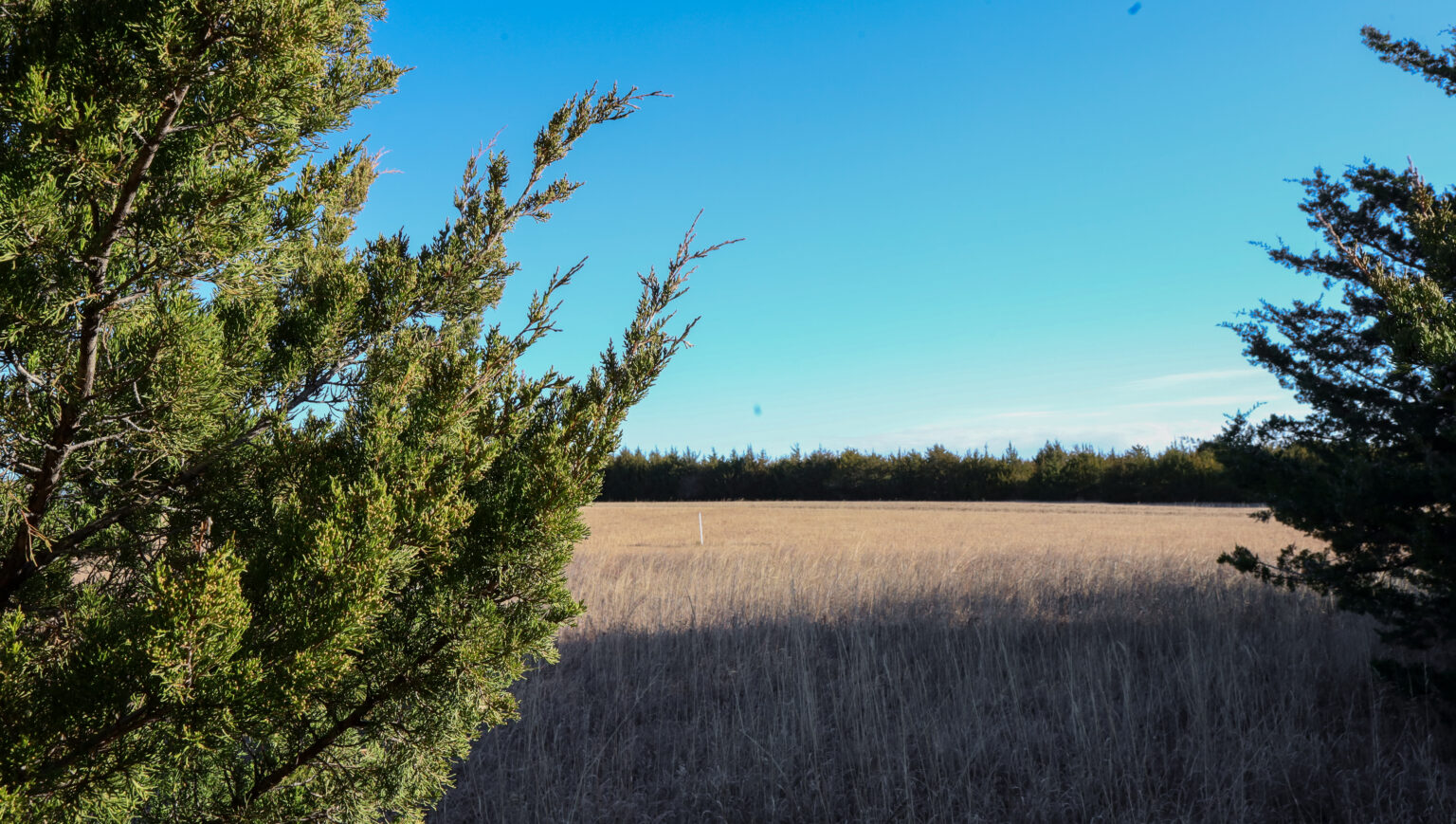
The highly flammable trees are everywhere in Kansas, including places they never used to grow.
Ecosystems across the state are undergoing a fundamental change. Prairie is being converted to forest as trees expand across the landscape, at the expense of grassland species. Woody encroachment, as this phenomenon is known, now converts more grassland in the Great Plains than row crop agriculture. Ranchers, conservationists and ecologists in Kansas have been documenting this shift for decades.
Kansas, however, is not alone.
“This is something that is happening in every grassy area on our planet right now,” said Jesse Nippert, a distinguished professor of biology at Kansas State University who studies woody encroachment. “Whether you’re talking about the steppes up in Alaska, whether you’re talking about sub-Alpine regions in Colorado, whether you’re talking about the Pampas and steppes in Argentina, this is literally happening in every grassland of our planet.”
“It is the single greatest conservation threat of what will be my lifetime,” Nippert added.
The causes are myriad, he said. While every region has unique factors, increased atmospheric carbon on a global scale plays an enormous role, researchers like Nippert have found. Trees, especially eastern red cedar, are thriving in arid regions of Kansas where they never before survived.
“As the CO2 continues to go up, the space that these plants can occupy also goes up, because now they can grow and survive on less water,” he said.
The repercussions extend beyond habitat loss to larger societal impacts, Nippert said.
Loss of rangeland for cattle is costing Kansas millions of dollars. Wildfires and tick-borne diseases are increasing, while available water has dramatically decreased. Woody species suck up more than twice as much water as grassland species, while their roots make the soils more porous, leading to further water loss. The changes are happening right down to the bedrock, Nippert said.
“It is a complete change in the fabric of the ecosystem,” he said.
Changes in land use are a major contributor to the increase in tree cover, but changes in land management also hold one of the keys to protecting what grassland remains, said Rob Manes, co-director of regenerative grazing lands strategy for the Nature Conservancy.
In Kansas, 15 million acres of grassland support cattle ranchers, the largest agricultural industry in the state. Regenerative grazing, a land management practice built on holistic practices such as prescribed fire and the rotation of cattle through pastures, encourages grassland resiliency and can keep species like eastern red cedar at bay.
“If we can establish a grazing regime that leaves enough residual grass to create a hot enough fire to kill cedar trees, then we increase forage for cattle, we increase drought resiliency, and we bring back lesser prairie chickens,” Manes said. “Economy and ecology, right there.”
An eastern red cedar tree establishes a foothold on Rockefeller Prairie, an experimental site at the University of Kansas field station north of Lawrence where researchers have studied burning and grazing as tools for land management.
An eastern red cedar tree establishes a foothold on Rockefeller Prairie, an experimental site at the University of Kansas field station north of Lawrence where researchers have studied burning and grazing as tools for land management. (Photo by Erin Socha for Kansas Reflector)
Across Kansas, from the tallgrass prairie of the Flint Hills to the shortgrass prairie out west, cattle ranchers find themselves on the front lines of woody encroachment and habitat loss.
But many ranchers are fighting back.
“Ranchers tend to think ecologically,” said Chris Helzer, director of science and stewardship for the Nature Conservancy of Nebraska. “They’re out there living in the ranch, because they love the nature around them, and they love the complex system. And they think about how to make that complex system stay complex and work for them.”
Grasslands, it turns out, not only benefit from grazing, but they need it to survive, said Phillip Simmonds, regenerative livestock manager for the Iowa Tribe of Kansas and Nebraska.
Phillip Simmonds, regenerative livestock manager for the Iowa Tribe of Kansas and Nebraska, says large grazing animals were fundamental to prairie’s evolution.
“That’s how the prairie systems evolved,” Simmonds said, “with a large grazing ruminant on it. So, if you don’t have them, you don’t have the prairies.”
For centuries, wild bison filled that role. Cattle, he said, are different but can achieve the same goals.
Justin Roemer, who manages both cattle and bison on the Smoky Valley Ranch near Colby, said that when cattle are rotated and pastures aren’t overgrazed, they provide similar benefits to grasslands.
“If you’re managing for resiliency, in that conservation strategy or regenerative way, I don’t think you’re going to see a difference in the way that they graze,” he said. “I say that because I haven’t seen an impact between where our cattle graze and where our bison graze.”
Regenerative grazing practices can look a little different throughout the state, depending on where the ranch is located, but the fundamental principles are the same, Manes said.
“Regenerative grazing is nothing new,” he said. “It’s what nature has done with grazing lands.”
But, he said: “There are ways to graze that don’t leave the land healthy. Regenerative grazing means the full scope of sustainable, which means that the ecosystem ends up healthy, the people who consume that animal protein that results from it end up healthy, and the economies of the communities that are involved in those enterprises are also healthy.”
_ _ _
Story via Kansas Reflector