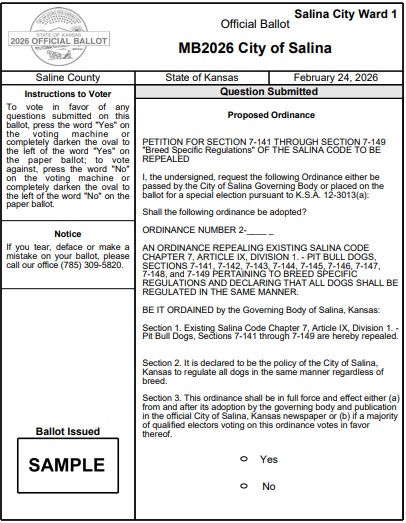
After over four decades of practicing law, I have cultivated extensive knowledge regarding the essential qualities of a “good law”: it must address a tangible problem, remain fair to those it affects, and, crucially, be capable of consistent and equitable enforcement. Breed-specific bans fail on all counts.
While these laws are often justified as public safety measures, empirical evidence shows they do not reduce dog bite injuries. By focusing on a dog’s appearance rather than its behavior, these ordinances divert limited municipal resources away from proven safety measures such as addressing neglect and abuse, strict enforcement of owner accountability, and investing in public education.
From a legal standpoint, breed bans, raise serious concerns. They rely on vague or inconsistent definitions, forcing law enforcement officers and the courts to make subjective judgments about a dog’s appearance. We are essentially asking officers to perform the impossible: identifying a dog’s genetic makeup by sight alone. Studies show that even trained professionals frequently misidentify breeds, with DNA testing directly contradicting visual assessments.
This subjectivity results in arbitrary outcomes and uneven enforcement, the inverse of what justice demands. Under these laws, two dogs with similar behavior can be treated entirely differently based solely upon physical characteristics.
The consequences extend beyond the legal system. Breed bans contribute to shelter overcrowding and deplete finite public resources. Pit Bull type dogs spend nearly three times as long in shelters when compared to other dogs, even when considering breeds that appear similar but lack the Pit Bull label. This stigma hinders adoption, increases shelter costs, and forces families to surrender well-behaved pets-not because of the dog’s actions or behavior, but because of the label.
Repealing Salina’s breed ban is not an abandonment of public safety. On the contrary, many communities have shifted to behavior-based, breed neutral policies. These policies focus on individual conduct, making them more effective, more humane, and more consistent with the principles embedded in our legal system.
Our legal system is built on the foundation of individual accountability. Regulations should be based on documented behavior and objective risk, rather than generalizations. By shifting to breed-neutral, behavior based policies, we ensure that the law is applied fairly to all owners while focusing enforcement on actual public safety threats. This is not just a more effective policy-it is a more rational application of our legal standards.
_ _ _
Robert German is an attorney in Salina with over 40 years of law experience.