From a young age, Matthew Shelly knew how he wanted to serve his country — from the cockpit of an aircraft.
“Growing up in Wichita, which is filled with not only McConnell Air Force Base, but there are also many retired aviation professionals, both military and nonmilitary affiliated,” said Shelly. “Being around all those people who were inspired by aviation and serving our country really made an impact on me. My dad also worked at Boeing Defense, so that had an impact as well.”
Shelly began flying airplanes in high school and eventually earned his private pilot license. With the foundation of his youth and an education from Kansas State University Salina, Shelly has worked his way through the ranks of the U.S. Air Force and is now one of the top leaders of the United States Pacific Command, or U.S. PACOM, headquartered in Honolulu, Hawaii.
Shelly, a 2005 K-State Salina graduate with a degree in professional pilot, is currently serving as a colonel and chief of plans and has had 10 different assignments throughout his career in the Air Force. These assignments have provided Shelly experience with flying aircraft like the A-10 at Moody Air Force Base in Georgia and in Korea, as well as the MQ-9 at Creech Air Force Base in Nevada.
His time at K-State Salina helped prepare him to tackle common aviation problems and be a leader in the Air Force. While he experienced success during his time on campus as a student, Shelly noted that is there he first learned to not only give feedback, but to also take it and understand that the feedback was meant to help him improve. This skill is something that he uses daily in the Air Force.
“I get paid to think about a specific problem, solutions to those problems, and then provide them to the command for their approval,” Shelly said. “What I like about that the most is the autonomy that we’re given. That ability to think of scenarios with the other planners to extremely difficult problems is very rare today, and I enjoy that.”
Sharing lessons in leadership
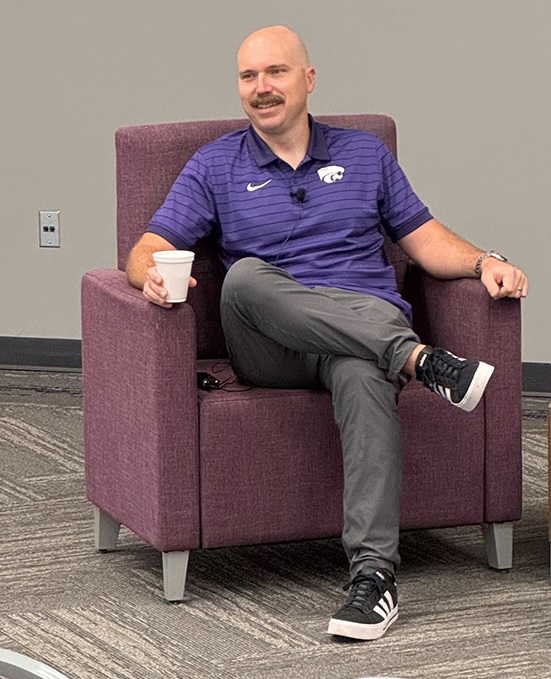
As this year’s Alumni Fellow for K-State Salina, Shelly and his wife were invited back to campus to share his expertise, experience and mentorship with students. The program, coordinated through the K-State Alumni Association, provides the opportunity for distinguished alumni to meet with students and faculty in the classroom and informal settings.
In his return to K-State Salina, Shelly noted his interest in seeing what current students are motivated by and their fresh view of aviation. With their entire careers in the industry ahead of them, he took the opportunity to provide mentorship and share his experiences and what he has learned.
“Seeing the motivation and their young futures and what the students are doing today is just super motivating for me, even 21 years after graduating,” said Shelly. “K-State Salina is still pouring into these future leaders and future aviators.”
What Shelly remembers the most about his time as a student at K-State Salina is the connection that he made with the students, faculty and staff on campus. This is a culture still evident upon his return to K-State Salina.
“K-State Salina in one word is community,” said Shelly. “If you go to K-State Salina and there was a student here during the time you were here, you probably knew each other. That community is what attracts people to a campus like K-State Salina.”
Flying into the future
With the rise of artificial intelligence, or AI, the aviation industry is experiencing a radical change — arguably one as big as when the Wright Brothers first flew in the early 1900s. Advanced Air Mobility, or AAM, is rethinking the need for a human in the cockpit of many aircraft, and with the rise of autonomous vehicles and aircraft, some wonder where that might put current aviation students in the next quarter century.
Still, with technology advancing, Shelly doesn’t see it as a threat to job security.
“I have a unique perspective on that, being that I spent three years doing uncrewed flight operations in the Air Force,” Shelly said. “Having that perspective makes me see that’s not one or the other. There will always be humans in the loop, and how we integrate humans into both the artificial intelligence piece and the uncrewed piece and the autonomous piece might be scary at first, but I think it’s going to be pretty exciting.”
_ _ _
Photo via K-State Salina