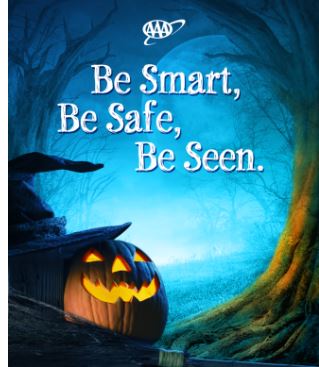
With Halloween falling on a Friday this year, ghosts and goblins, trick-or-treaters, parents, and party goers too, should beware of a weekend filled with the heightened traffic safety concerns.
According to AAA Kansas, increased pedestrian activity and the potential for impaired driving converge on Halloween, as it falls on a Friday this year – meaning trick-or-treating and parties alike on the holiday itself and throughout the weekend. In addition, the end of Daylight Saving Time early Sunday morning (Nov. 2) means drowsy driving as motorists adjust to the time change and fewer daylight hours.
meaning trick-or-treating and parties alike on the holiday itself and throughout the weekend. In addition, the end of Daylight Saving Time early Sunday morning (Nov. 2) means drowsy driving as motorists adjust to the time change and fewer daylight hours.Halloween Dangers – Child Pedestrian Safety and Drunk Driving
A scare in good fun is expected on Halloween, but not when it comes to child pedestrian safety.
-
According to Safe Kids Worldwide, children are more than twice as likely to be hit by a car and killed on Halloween than any other day of the year.
-
The National Highway Traffic Safety Administration (NHTSA) reports that Halloween is consistently one of the top three days of the year for pedestrian injuries and fatalities.
-
Deadly after dark – the nighttime fatality rate on U.S. roadways is three times higher than the daytime rate, and 76% of pedestrian fatalities occur at night, according to the Federal Highway Administration (FHA).
-
About 40% of Halloween crash fatalities involve drunk drivers (NHTSA).
Creative costumes, trick-or-treating and bags full of goodies become top Halloween priorities, however safety should always be the top priority. Excited trick-or-treaters can forget about safety, so drivers, party-goers and parents must be even more alert, as the risk of kids being injured by moving vehicles increases on Halloween night.
“Halloween notoriously brings an increased risk of pedestrian crashes, especially involving children. It is critical for parents to make trick-or-treaters and their costumes safer and more visible to motorists,” said Shawn Steward, manager of Public and Government Affairs for AAA Kansas. “Drivers must also do their part by slowing down, eliminating distractions, and watching out for children, as well as have a sober designated driver if drinking is part of your Halloween celebration. A safe Halloween starts with smart choices behind the wheel and on the sidewalk.”
Halloween is a statistically dangerous night for drunk driving. Because of parties, trick-or-treating, and other festivities, Halloween night can be especially dangerous on our nation’s roads. According to NHTSA:
-
From 2019 to 2023, on Halloween night, (6 p.m. October 31-5:59 a.m. November 1):
-
198 people were killed in alcohol-related crashes, which involve at least one driver who had a blood alcohol level of .01 or higher.
-
176 people were killed in crashes that involved a drunk driver, with BACs of .08 or higher. Victims in those drunk-driving crashes included 30 pedestrians and 145 drivers and passengers.
-
People killed ages 21-34 (54%) were overrepresented in drunk-driving fatalities.
-
“Halloween is a time to make happy memories, not tragic nightmares,” said Steward. “The only thing scarier than zombies and witches loose on the streets is an impaired driver.”
In Kansas, the Kansas Department of Transportation (KDOT) reports:
-
During Halloween (2019-23), there were nearly 200 alcohol related crashes, resulting in 100 injuries and 3 deaths.
AAA Halloween Safety Tips
Motorists
-
Eliminate distractions while driving, focus on the road and trick-or-treaters.
-
Slow down and obey all traffic signs and signals, give yourself extra time to react to children who may dart into the street.
-
Look for children crossing the street. They may not be paying attention to traffic and may cross the street mid-block or between parked cars.
-
Carefully enter and exit driveways and alleys, taking extra care if you are backing up or turning.
-
Turn your headlights on to make yourself more visible – even in the daylight.
Parents
-
Make sure Halloween costumes are flame-retardant and light in color to improve visibility.
-
Be bright at night – have trick-or-treaters use glow sticks or wear retro-reflective tape on costumes and on treat buckets.
-
Ensure face masks/costumes don’t obstruct vision.
-
Ask an adult or older child to supervise children under age 12.
-
Instruct children to travel only in familiar areas and along established routes.
-
Teach children to stop only at well-lit houses and to never to enter a stranger’s home or garage.
-
Review trick-or-treating safety precautions, including pedestrian and traffic safety rules.
Trick-or-Treaters
-
Stay on sidewalks and avoid walking in streets if possible.
-
If there are no sidewalks, walk on the left side of the road, facing traffic.
-
Look both ways and listen for traffic before crossing the street.
-
Watch for cars turning or backing up.
-
Cross streets only at the corner, using traffic signals and crosswalks, and never cross between parked vehicles or mid-block.
-
Trick-or-treat in a group if someone older cannot go with you.
-
Tell your parents where you are going.
-
Carry a flashlight containing fresh batteries. Never shine flashlights into the eyes of oncoming drivers.
Party Goers
-
Arrange a safe ride home and/or designate a sober driver before partaking in any festivities.
-
Utilize ride share service, public transportation, and/or a sober friend or family member.
-
Walking impaired can be as dangerous as drunk driving. Designate a sober friend to walk you home.
-
If you see a drunk driver on the road, contact local law enforcement.
-
If you know someone who is about to drive or ride impaired, take their keys and help them make safe travel arrangements to where they are going.
Party Hosts
-
Be responsible and make sure guests get home safely.
-
Prepare to coordinate rideshares, provide accommodations, or drive guests home.
-
Collect keys from guests who are drinking.
-
Provide non-alcoholic beverage options.
End of Daylight Saving Time (DST) on Sunday, Nov. 2
Beginning at 2:00 a.m. on Sunday, November 2, Daylight Saving Time (DST) will end. The time change can cause disturbed sleep patterns, and when combined with the earlier dusk and darkness during the evening commute, become a formula for drowsy driving and fatigue-related crashes – conditions many drivers may be unaware of during the time change.
“The end of Daylight Saving Time will bring shorter days and longer nights,” said AAA’s Steward “While the extra hour of sleep may be just what many need after Halloween weekend festivities, it brings added dangers on the roadways. AAA urges motorists to slow down, increase following distance, and use headlights to be more visible as late afternoons/evenings will be darker on the roadways.”