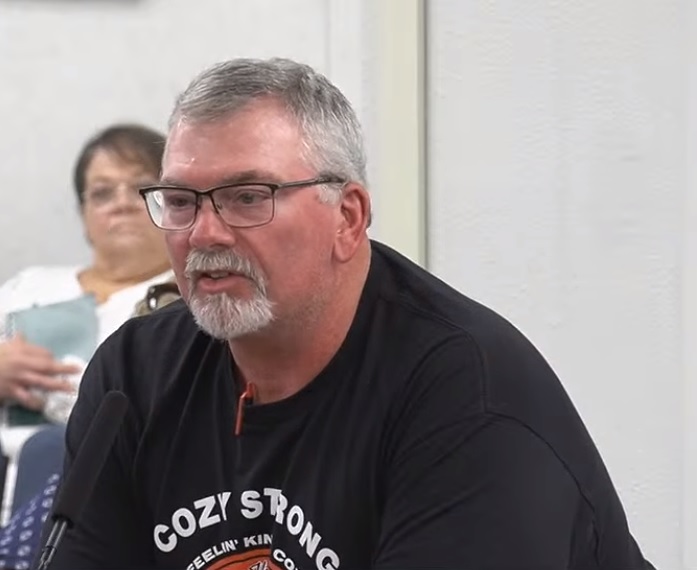
A Salina man is starting an effort to change the Salina city government structure.
According to Anthony Johnson, he has submitted two petitions to Saline County Counselor Mike Montoya. These petitions would give voters the option to change Salina’s government by voting “yes” to the following two ballot questions in next year’s November elections:
- Shall the City of Salina, Kansas abandon the commission-manager form of government?
- Shall the City of Salina adopt the mayor-council manager form of government and become a city operating under such form of government?
Salina has had a commission-manager form of government for 105 years, dating back to 1921. A commission-manager form of government is a local government structure where an elected governing body (a commission) sets policy and hires a professional manager to oversee day-to-day administration. I
A mayor-council manager form of government pairs an elected council and mayor with a professional city manager appointed to run daily operations. Voters choose the governing body to set policy and pass laws, while the manager handles administration, budgeting, and staffing
Johnson says Montoya’s review is to be complete next week. He plans to circulate the petitions for signatures within the next few weeks. Under Kansas law, the petitions must be signed by at least ten percent (10%) of the most recent number of registered Salina voters according to the secretary of state.
A “yes” vote on both questions would result in a new form of government for Salina. Beginning in 2029, voters would elect four council members from neighborhood wards and a mayor elected at-large. That setup would replace the current form of government, which features each of five commissioners elected at-large, one of whom serves as mayor.
“Voting ‘yes’ on these ballot questions would help political power be more evenly distributed throughout the city,” Johnson said.
If a majority votes in favor of the ballot questions, the new form of government becomes effective beginning with the regular city election in November of 2029.
Meanwhile, officials elected under the old form of government in 2027 would be required to establish the boundaries of each ward well in advance of the 2029 election. Each ward would be required to be as equal in population as practicable, and the territory of each ward would need to be contiguous and compact.
The mayor, elected at-large, would serve a two-year term. Each of the four council members would be elected from the ward in which the member resides for a term of four years. Council member terms would be staggered so that two of them are elected at each regular city election.
At the November 2029 regular city election, the council members elected from two of the wards would serve initial terms of four years. The council members elected from the other two wards would serve initial terms of two years solely for the purpose of establishing staggered terms. Beginning with the November 2031 regular city election, Council Members from each ward would be elected every four years.
For his part, Johson thinks it’s time to get away from “business as usual” at city hall. “I look forward to getting out in the community to discuss these issues,” he said. “It’s a privilege for all of us to participate so directly in democracy.”