Drones are becoming an increasingly important tool for farmers seeking to improve efficiency and crop management, according to a Kansas State University precision agriculture expert.
Deepak Joshi, a faculty member in K-State’s Department of Agronomy, said the growing use of drones in early-season crop scouting can help producers quickly assess plant germination, stand counts and field conditions while reducing labor demands.
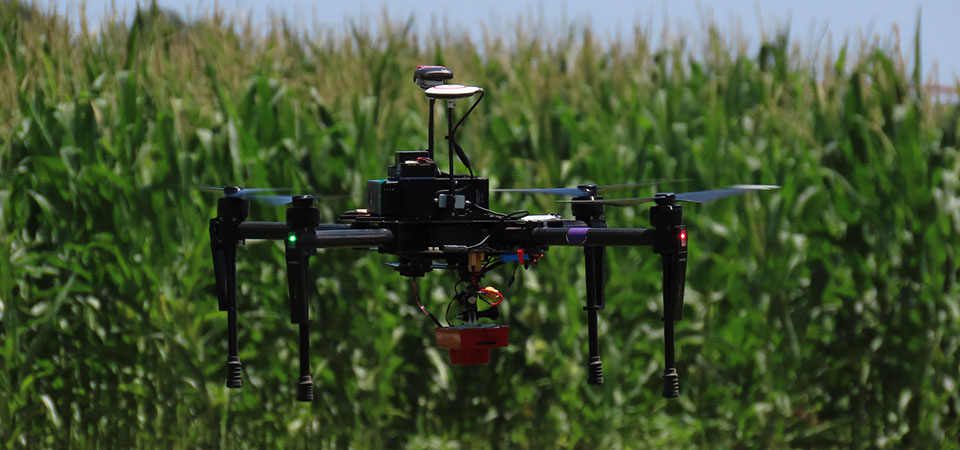
Drones equipped with RGB and multispectral imaging systems allow farmers to gather detailed information about crop performance in a fraction of the time required for traditional scouting methods.
“If you think about the amount of time it would take to physically walk a field and collect that data, drones can significantly reduce that workload,” Joshi said.
Joshi cited an example of a 150 acre field that would take at least a half-day to scout manually. Using a drone, the same field can be covered in about 30 minutes, providing growers with timely insights during critical stages of crop development.
During the early growing season, the technology is especially useful, Joshi said, because producers are evaluating seed emergence and determining whether replanting decisions may be necessary. Drone imagery can identify uneven germination patterns, gaps in plant stands and other issues that may not be immediately visible from ground level.
In addition to early-season field scouting capabilities, drones are also being used throughout the season to monitor crop health and identify nutrient deficiencies, moisture stress, insect damage and disease pressure. Multispectral imaging systems can detect subtle changes in plant vigor, helping producers respond to problems before visible symptoms become widespread.
While the technology offers substantial labor savings and high-quality data collection, experts cautioned that drones are not a completely hands-off solution.
“Manual validation is still important,” Joshi said. “You still need someone in the field to confirm what the imagery is showing.”
Joshi noted some challenges facing broader drone adoption in agriculture, one being the requirement for operators to obtain a Federal Aviation Administration license before using drones commercially.
The FAA’s Part 107 certification process includes passing an aeronautical knowledge exam and complying with federal flight regulations. Industry specialists say the licensing requirement can discourage some producers from adopting the technology themselves, leading many to rely on custom drone service providers.
Another challenge involves processing and managing the large amounts of image data drones collect. Depending on field size and image resolution, processing files can require significant computing power and specialized software.
“That’s where K-State can help,” Joshi said. “We can help them collect the drone images from their field and process them. We are happy to help to use these technologies.”
More information is available at local extension offices in Kansas.
Joshi noted that K-State has continued expanding its efforts to support precision agriculture technologies, including drone applications aimed at improving crop management and production efficiency.
***