In livestock disease response, timing determines whether an outbreak is contained or cascades through the entire production system. Research from Kansas State University suggests that the window may be as short as eight to 10 days.
In modeling scenarios, outbreaks detected within that timeframe remained relatively small. When detection came later, the scale increased quickly, reaching hundreds or even thousands of operations.
K-State experts presented this research and more to livestock producers, veterinarians and industry partners at the Animal Health Intelligence Summit this spring, hosted by Tom Hones at the HP Spur. The summit was convened by K-State’s Institute for Digital Agriculture and Advanced Analytics and National Agricultural Biosecurity Center.
By engaging this deliberate cross-section of professionals responsible for keeping Kansas livestock healthy and the food system moving, K-State continues to drive innovative and practical solutions to the challenges facing the livestock system today.
What the models show
Mike Sanderson, professor and associate director of K-State’s Center for Outcomes Research and Epidemiology, uses national-scale epidemiological models to simulate how disease moves through U.S. livestock systems. Disease does not spread randomly; it follows the same routes cattle travel every day.
Kansas sits at the center of that system. The state’s southwest corner forms the Golden Triangle, the intensive feedlot and meatpacking corridor connecting Dodge City, Garden City and Liberal that processes roughly 20-25% of the nation’s beef. Auction markets concentrate animals from multiple sources, sort them and redistribute them across the region.
In simulations, a single infected herd entering an auction market can generate multiple new infections in a single day.
“Auction markets can multiply infections quickly,” Sanderson said. “But they’re also critical to the industry. You can control disease aggressively, but if you go too far, you can destroy the industry.”
Traceability — the ability to identify where animals have been and which operations they have been in contact with — is one of the most consistent factors shaping outcomes. When tracing improved in the models, large outbreak size declined, in some cases by hundreds of infected operations, in others by a thousand or more.
“Traceability matters,” Sanderson said. “It reduces both the size of outbreaks and the number of farms impacted.”
The economic stakes are concrete. Export markets account for roughly $423 per head of fed cattle. A confirmed foreign animal disease would shut down those markets immediately, sending ripple effects through prices, supply chains and rural economies.
Threats already at the door
Kansas Department of Agriculture Animal Health Commissioner and State Veterinarian Justin Smith addressed threats already pressing at the system’s edges. A Kansas native with more than 15 years of large animal veterinary experience and a decade managing a cow-calf and stocker ranch, Smith brought a producer’s perspective to the regulatory role.
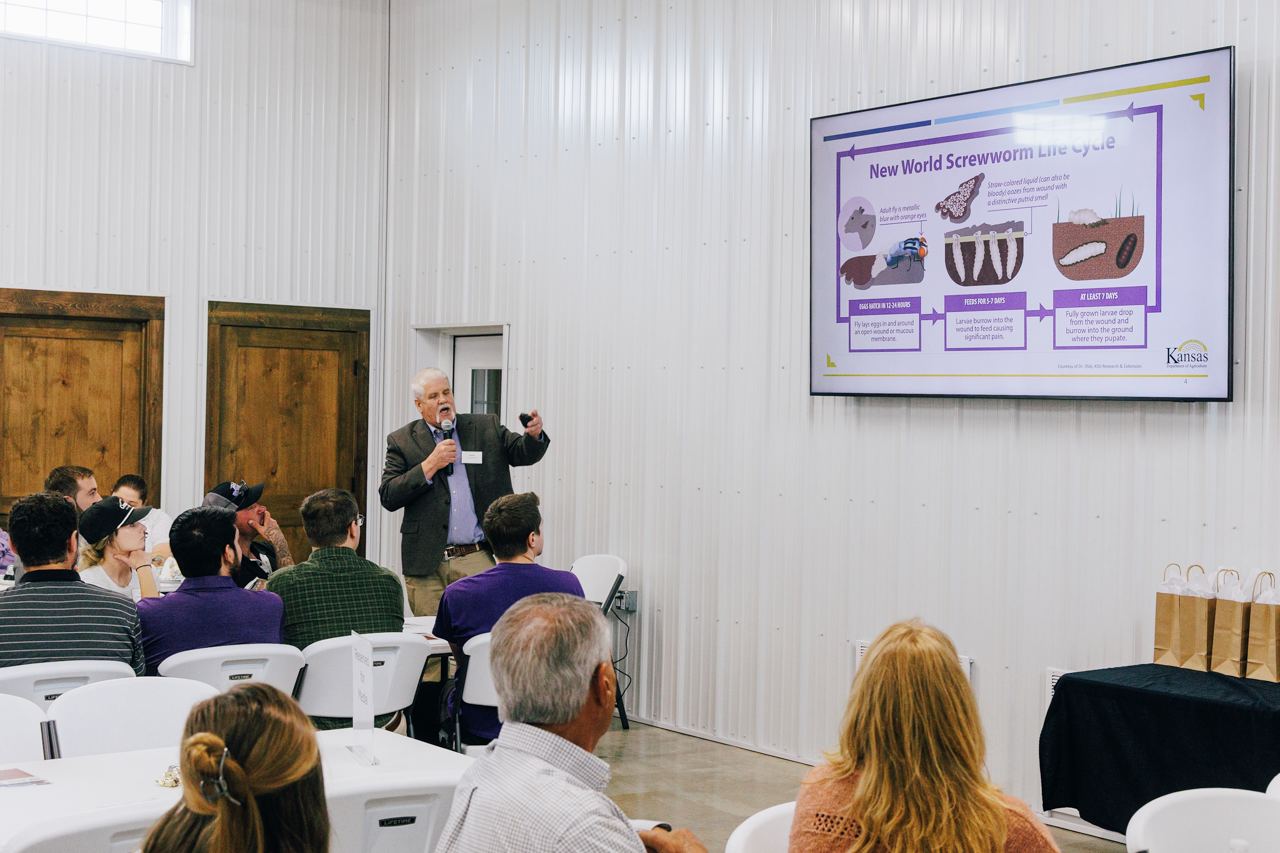
New World screwworm is among the threats he highlighted. Unlike contagious diseases, screwworm is an infestation — flies deposit eggs in wounds or moist tissue, and larvae feed on living tissue as they develop. Detection depends almost entirely on what producers observe in the field.
“There’s no better way to mitigate this than to inspect animals,” Smith said. “This isn’t looking over a fence or through a truck. It’s a hands-on inspection.”
In 1972, Texas recorded roughly 90,000 cases of New World screwworm within about two years. Response to a Kansas event would establish a 12.4-mile infested zone around confirmed cases, with quarantine and movement restrictions extending outward.
“It’s a tropical fly,” Smith said. “It likes humidity and moisture — but that doesn’t mean it can’t move here.”
The Asian longhorn tick presents a different challenge. First identified in the U.S. in 2017, it reproduces without males and has spread rapidly across the eastern United States. It can transmit Theileria, a blood-borne disease that does not respond to treatments used for similar conditions.
Cases in Kansas are increasing, and the disease is likely underdiagnosed and underreported.
“We’re seeing more cases every day,” Smith said. “We need more work on this disease — we don’t know enough yet to answer a lot of these questions.”
The work ahead
The summit’s cross-sector design was intentional. Savannah Greiner, who leads emergency response and preparedness outreach at K-State, said the land-grant mission shapes how research reaches the people who need it.
“We are a land-grant institution. We’re across the whole state,” Greiner said. “The work we do — emergency management, outreach, preparedness — it affects everybody.”
Susan Metzger, director of strategic interdisciplinary program development and the Kansas Water Institute at K-State, placed the stakes in broader terms.
“
When we talk about preparing for animal disease outbreaks, we’re not just talking about protecting individual herds,” Metzger said. “We’re talking about protecting the systems that move food from producers to consumers. The more prepared we are here, the more we are supporting not just Kansas, but the broader region and the nation’s food supply.”
The research does not suggest that outbreaks can be avoided entirely, but it shows that outbreak size and impact are shaped early by how quickly they are detected, how clearly movement can be traced and how precisely response measures are applied.
Those decisions are made in real time, with incomplete information, and the margin for error is measured in days.
“Our responsibility is to make sure research doesn’t stop at discovery,” said Dan Moser, Eldon Gideon dean of K-State’s College of Agriculture. “It has to reach the people making decisions every day — and it has to hold up under the real conditions they’re working in.”