When considering how to pass on a family farm or ranch to the next generation, one of the biggest mistakes families often make is not having “the talk.”
“If you ask farmers and ranchers ‘What do you want to have happen to your farm after you’re gone?’ almost unanimously the answer is to keep it together and keep the family farming,” said Shannon Ferrell, a professor at Oklahoma State University department of agricultural economics, specializing in agricultural law.”
“Doing nothing is not the way to do that. If you do nothing, you are basically guaranteeing that you’re breaking up the farm and possibly your family as well.”
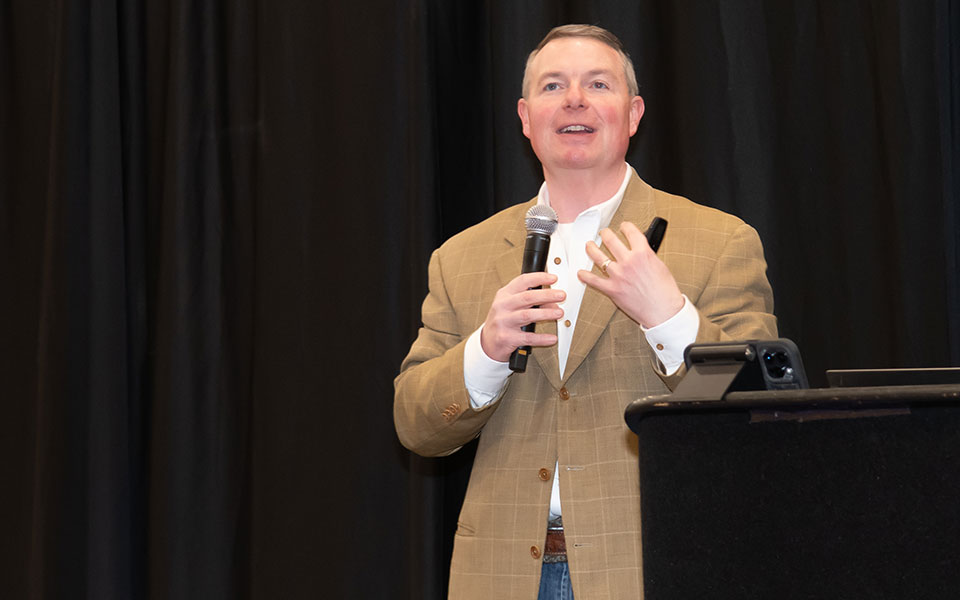
Ferrell was the keynote speaker during the 113th Cattlemen’s Day, hosted by the K-State Department of Animal Sciences and Industry, on March 6. The day-long event featured several presentations on such topics as using genetic tools to select the next generation of females, to beef cow size and the impacts it has on the cow herd and feedlots.
Ferrell said there are two questions producers need to ask themselves when they are looking towards a generational transfer:
- What’s your vision of the future of your farm or ranch?
- What’s your vision of the role you will play in the future?
“Once these two questions are answered and understood, it allows families to start making those decisions with the best information available knowing how you view it but also knowing how the people around you view it as well and understanding their expectations,” Ferrell said.
“When initiating the talk about generational transfers, no matter what generation is starting the conversation, respect is always the watchword for everything. If we feel respected, we can have good, honest conversations.”
Ferrell explained that the hardest part of a generational transfer is for producers to understand that they do not have to completely step away from the operation.
“They have worked their life to become CEO of their operation,” he said. “But there is a job above CEO; that is, chairman of the board.”
By stepping into an advising role, it allows producer’s families to learn how to run the operation, by still having the invaluable experience from the generations, Ferrel said.
“You’re letting that next generation grow into management roles without them having to do it all at once,” Ferrell said. “If a producer can provide the benefit of their experience first-hand, the next generation does not have to repeat those mistakes.”
Ferrell said the earlier you start planning a generational transfer, the better.
“If a producer knows that they have one or more kids coming back to the operation, they have that time period to start planning,” he said. “They can use all kinds of tools to make the transition economically good for them without it being a strain on anybody, turning something into opportunity, versus it being a burden”
Time is the biggest asset in generational transfers, especially if a member of the next generation does not want to come back to the operation, Ferrell said.
“Many producers do not have a lot of non-farm assets, so they’re very concerned about what they are going to pass onto an heir that is not coming back,” Ferrell said. “The benefit of more time gives the opportunity to create off-farm investments, giving the producer the opportunity to gift something to that non-farm heir that is not coming back.”
Ferrell said that the biggest thing he hopes producers take away from his presentation, is to have the conversation.
“If you have that conversation, you can provide an understanding of why you’re doing what you’re doing, learn people’s expectations, or maybe set people’s expectations and manage those expectations,” he said. “But if you don’t have that conversation, people are going to fill in the blanks about what your motivations were, and they generally don’t give you the benefit of the doubt.”
“When we have the conversation,” he added, “we have the opportunity while we’re alive to manage the transfer of the operation and engage with it in a respectful way.”