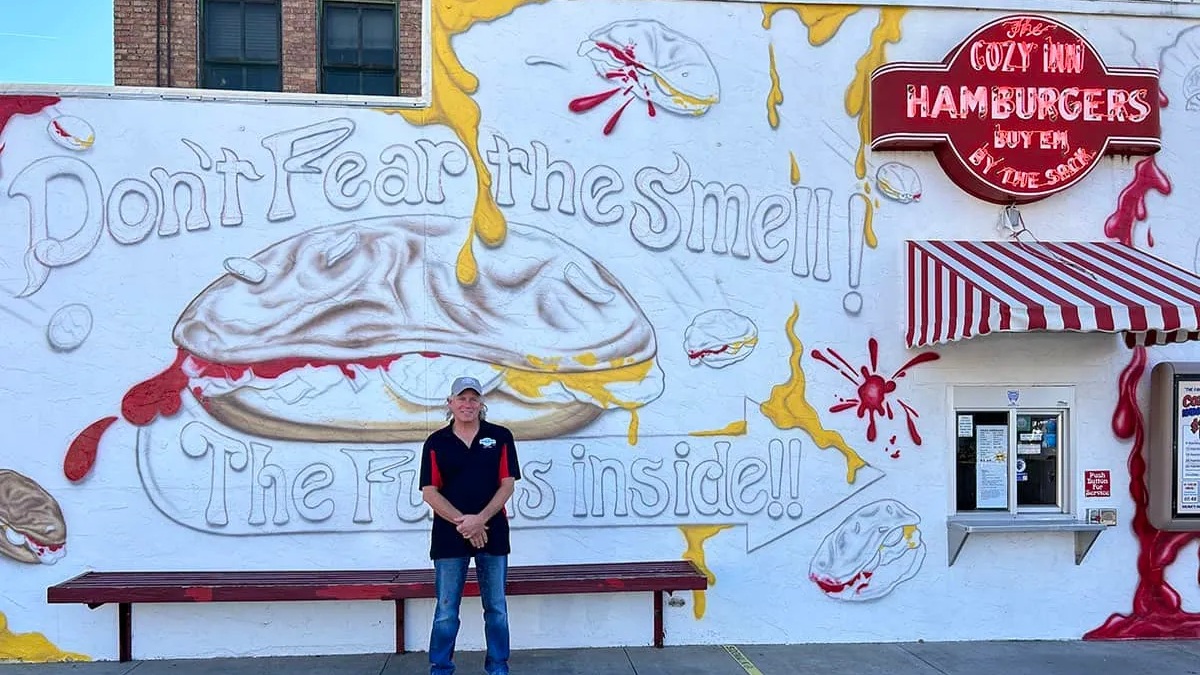
The U.S. Court of Appeals for the Tenth Circuit has ruled in favor of The Cozy Inn in a free speech fight with the City of Salina over UFO-themed mural depicting flying burger-esque UFOs. The Court affirmed the trial court’s ruling that Salina violated the First Amendment.
Steve Howard, owner of the iconic burger joint, filed the lawsuit with help from Kansas Justice Institute in early 2024 after Salina officials told him to stop painting the mural. Salina considered the artwork a regulated sign instead of an unregulated mural. That’s because, according to Salina, the mural depicted UFOs that looked too much like hamburgers, The Cozy’s signature item. The Cozy has been a Salina institution for over a century, serving hamburgers from its small storefront since 1922.
According to the Kansas Justice Institute, the decision has implications far beyond The Cozy Inn and its mural. The Court made clear that when the government tries to regulate speech, artwork, or expression, it must have hard evidence supporting its speech restrictions, not mere speculation. Cities across the country attempt to restrict speech through sign codes just like Salina’s, which is why this case has attracted national attention, drawing friend-of-the-court briefs supporting The Cozy’s First Amendment challenge from the National Federation of Independent Business, Institute for Justice, Pacific Legal Foundation, Liberty Justice Center, Alliance Defending Freedom, and a joint brief from Goldwater Institute and Manhattan Institute.
“Salina is my hometown, I love it here,” says Mr. Howard. “The reason I love this community, this town, is because of all of the support everyone has given me. Thank you for standing behind me and supporting me through this,” Howard continued.
“Salina’s code would have allowed Steve to paint a mural depicting flying pizza slices, but not burger-esque UFOs, just because The Cozy sells sliders,” said Sam MacRoberts, KJI litigation director. “We’ve said from the very beginning that Salina’s code—and the way it was enforced—was unconstitutional,” MacRoberts continued.
“This ruling makes it clear to all of the cities in Kansas: quit playing art critic,” MacRoberts said.
“I’m incredibly proud of Steve for standing up for his First Amendment rights. And I’m so happy the mural gets to stay up—it’s an awesome piece of artwork. Salina’s mural scene is better off for it,” MacRoberts continued.
The Tenth Circuit’s opinion contains the following quotes:
“Cozy Inn counters that ‘Salina must produce evidence that its restrictions advance, and are tailored to, its interests’ and that Salina failed to do so. We agree with Cozy Inn.”
“Salina’s evidence failed to justify the distinction between regulated signs and unregulated murals. It did not show that signs pose greater danger to Salina’s interest in safety, aesthetic, and property values.”
“Given that Mr. Howard’s application has aged for three years without his consent, Salina imposed a prior restraint on his speech.”
_ _ _
Photo via Kansas Justice Institute