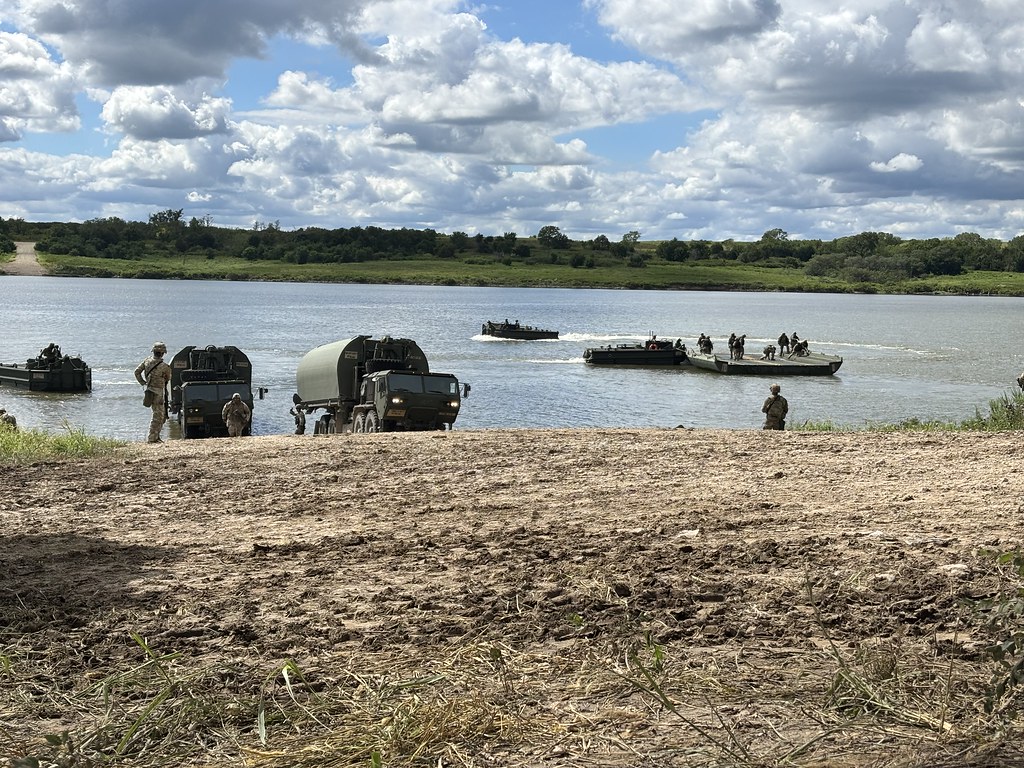
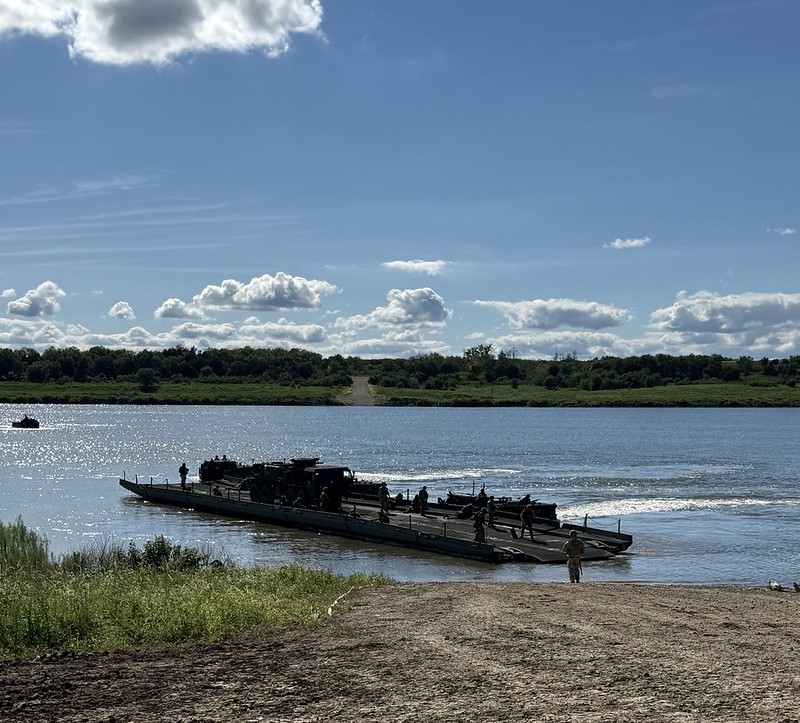
A float bridge building exercise at Milford Lake was an aid to engineer training for a group of Fort Riley soldiers.
According to 1st Infantry Division Public Affairs Office soldiers of the 175th Multi-Role Bridge Company, 5th Engineer Battalion, successfully certified their bridge sections in tactical float bridging and reconnaissance operations during a week-long field evaluation at Milford Lake.
The exercise marked the unit’s Bridge Crewmember Qualification Table V, a rigorous section-level evaluation designed to validate whether combat bridge crews can operate independently under realistic battlefield conditions. Over the course of the training, engineer sections conducted day and night river reconnaissance, assembled multi-piece floating rafts, and defended assembly sites against simulated enemy attacks.
The milestone serves as the capstone evaluation for the “Tritons” of the 175th Multi-Role Bridge Company in their first full year since activation, paving the way for larger joint operations alongside frontline combat and armored units in the upcoming year.
Multi-role bridge companies are specialized combat engineer units responsible for deploying floating ribbon bridges and motorized rafts, enabling heavy vehicles, tanks, and ground forces to cross water obstacles quickly when permanent bridges are destroyed or unavailable.
During the 24-hour continuous evaluation cycles, soldiers worked in temperatures exceeding 100 degrees Fahrenheit while wearing full combat gear, including body armor and helmets. Sections constructed seven-bay interior rafts (floating ferry platforms pieced together from interlocking aluminum bridge bays propelled by bridge erection boats) to transport equipment across open water.
Throughout the build, training evaluators subjected crews to simulated opposing forces, including ground-level small arms fire and attacks by unmanned aerial systems, commonly known as drones. Despite the disruptions, crews completed their builds, conducted tactical displacements to alternate staging positions, and secured their perimeters.
“BCQT Five was where individual proficiency transformed into combat power,” said Capt. Drummond, company commander of the 175th Multi-Role Bridge Company. “By rigorously certifying our junior leaders and noncommissioned officers at echelon, we decentralized command and control, giving our platoons the autonomy to solve complex tactical problems under fire.”
Drummond emphasized that technical assembly speed represents only one facet of combat engineering.
“True lethality isn’t just about build times; it is our verified ability to shoot, move, communicate, and sustain across multi-domain environments over extended, high-tempo operations,” Drummond said. “When our leaders own their roles at every level, we don’t just build bridges faster. We ensure the maneuver force can cross any gap, endure any friction, and maintain the relentless momentum required to dominate the modern battlefield.”
For the junior officers and enlisted soldiers conducting the physical assembly on the water, the evaluation reflected months of progressive training from foundational soldier skills to synchronized crew operations.
“BCQT Five was our first time being evaluated at our job since the company activated last summer. From twelve months ago to now, it is a night and day difference in how far we have come in our training,” said 1st Lt. Isabel Petrin, a platoon leader in the unit. “The main thing I took away from this training event is how it really takes each individual soldier and leader owning their role and knowing their job to make these missions happen.”
Petrin added that rapid deployment is vital to preserving battlefield momentum.
“For an MRBC, the biggest objective is to be fast because we want to get the maneuver units across the water as quickly as possible. Every action and decision can cost valuable seconds and minutes on the battlefield,” Petrin said. “The best part of this field training exercise for me was seeing the passion each of my soldiers and NCOs have for their jobs. They love being 12Cs [bridge crewmembers] and they want to make each bridge build better than their last one.”
Senior enlisted leadership pointed to the harsh environmental conditions and realistic adversary injects as the ultimate test of crew endurance.
“Executing continuous, multi-domain operations in thermal conditions exceeding 100 degrees Fahrenheit while in full combat load, the platoon demonstrated outstanding tactical proficiency and resilience,” said Sgt. 1st Class Garrett, platoon sergeant. “Despite opposing force injects including small arms contact and unmanned aerial systems strikes, the unit maintained command and control, yielding maximum training readiness and proving our capability to operate in high-threat, degraded environments.”
Junior crewmembers credited the structured training progression with building team cohesion and confidence on the water.
“We were a lot more prepared for the evaluation than I expected. The training we put in for this field prepared us to excel,” said Pfc. Carter Justice, a bridge boat operator whose section posted the fastest build time in the company. “I enjoyed the camaraderie and how we all worked together to achieve a common goal. The training increased our lethality by motivating us to work faster and harder to outwork the enemy. If we work faster and harder than the enemy, we will win.”
Pfc. Strong, a bridge crewmember, noted that the exercise tied individual fundamentals into collective capability.
“Finally seeing all the different individual and crew tasks we’ve been practicing over the past few months just come together so well during BCQT V really aided in not only an important mission completed successfully but also helped put the reasoning of our training schedule into perspective,” Strong said. “It makes sense to master how to crawl before you can walk.”
With this certification complete, the 175th Multi-Role Bridge Company will transition into collective river-crossing operations integrated with combined arms maneuver units in the upcoming training year.
_ _ _
Photos via 1st Infantry Division Public Affairs Office