A day before he retired in March 2025, deputy prosecutor Rick James emailed three Salina police officers about “Bunce the Clown.”
Micah Bunce was a former city cop now working for the public defender’s office. A few months earlier, Bunce had testified in support of a woman who was caught with a meth pipe in her bra, saying police had field tests that could have determined whether the pipe contained “Shazzle,” street slang for a kind of bath salts, as she claimed.
Police officers disputed Bunce’s testimony. In the email, James encouraged Capt. James Feldman, Sgt. Andrew Zeigler and evidence technician Evan Londo to produce an affidavit that would allow the county attorney to charge Bunce with perjury.
If they simply complained to Bunce’s bosses, James reasoned, “it is probably 50/50 they’ll fire him.”
“If we take my approach and actually file on him, I think it’s a 100% they fire him,” James wrote.
Feldman prepared the affidavit, and Bunce was charged with perjury, a felony that carries a minimum five-month prison sentence and a fine of up to $100,000. But evidence showed his testimony was accurate, and the case eventually was dismissed.
The stress of being arrested, booked and bound over for trial coincided with his wife battling a terminal illness.
In May of this year, Bunce filed a federal civil lawsuit accusing James and the three officers of conspiring to fabricate a perjury charge to get him fired.
“It’s been very difficult for my own personal life, for my home life,” Bunce said in an interview outside a downtown Salina coffee shop. “I still have children at home. My wife is ill, so having to deal with a lot of different aspects, and this was just piled up on top of those things at the same time.
“No one wants to be told they can’t come to work and do what they enjoy doing, and what provides for their family, and that’s ultimately what happened here, was that was taken away from me.”
An attorney for the police officers declined to respond to questions for this story. Court records show the officers deny Bunce’s accusations of malicious prosecution, fabrication of evidence, retaliation for testimony, civil rights conspiracy, abuse of process and intentional infliction of emotional distress.
James declined to answer questions for this story but said he was always kind to the press during his 25 years as a prosecutor.
“If you have been a reporter very long, I am certain you have learned that many of the allegations in any civil lawsuit turn out not to be true or lack basis in fact,” James said in an email. “As an experienced trial attorney, I know better than to talk about the facts of any case, civil or criminal, while that case is ongoing.”
Testing capabilities
Bunce said he grew up in New Mexico and moved to Kansas because his wife is from the Garden City area.
“Sometimes the wind blows you in, and you just kind of stay here and make it your new home,” he said.
From 2006 to 2013, he served as sheriff of Kearny County, where there are fewer than 4,000 people spread across 871 square miles in southwest Kansas. He decided he “wanted to see more things.” He landed a job as a Salina Police Department officer and said he left six years later because “I was at a point in my life when I wanted to do something different.”
After the pandemic hit, Bunce worked for a local drug and alcohol rehabilitation organization and then the Boy Scouts of America. He joined the Salina regional public defender’s office as a special investigator in 2023.
In October 2024, he was called to testify for the first time on behalf of a defendant. Ashley Dempsey had been caught with the meth pipe, and Bunce said that as a police officer, he had access to a “plethora” of NARTEC test kits that could identify bath salts.
Aside from being true, the testimony was immaterial, he argues in his lawsuit. Dempsey eventually pleaded guilty to possessing meth.
There is nothing in the public record that explains why police were so bothered by Bunce’s testimony. But internal emails, which Bunce’s attorneys obtained through open records requests, show police discussed the testimony for months before Feldman produced a charging affidavit. The perjury accusation was based on the distinction that police never had tests that were manufactured specifically for bath salts.
Londo, the evidence technician, testified at Bunce’s preliminary hearing on July 10, 2025, that the department started using NARTEC tests in 2019, right after Bunce left. But six weeks earlier, on May 22, 2025, Londo had drafted a memo that said police had used the tests since 2015, when Bunce was on the force.
Londo was confronted on the witness stand with the discrepancy between his memo and his testimony.
“It’s just kind of what I’ve heard from other officers and based off their reports from that time period,” he said, while explaining he had only been at the police department since 2022.
Zeigler, the other officer named in Bunce’s lawsuit, wrote a report in April 2025 that said the department only had NARTEC test kits for meth, cocaine and heroin.
That wasn’t true. The president of NARTEC testified at the July 2025 hearing that the company’s test kits could identify bath salts.
‘Fair amount of outrage’
Kelson Bohnet was among the 20 to 30 defense attorneys who showed up at the July 2025 hearing to support Bunce.
Bohnet, a former public defender for the state who now works on federal cases, said news of the charge against Bunce spread quickly among public defenders.
“As you can imagine,” he said, “there was a fair amount of outrage.”
He rearranged his schedule to travel to Salina for the hearing. He didn’t know the details going in and thought it “seemed very strange as a spectator” that there was such a “hyperfocus” on whether a singular test could be used for both meth and bath salts.
Londo’s testimony was “very obviously questionable,” Bohnet said. In fact, he said, “it struck me as a much more just blatantly objectively false statement” than what Bunce was prosecuted for.
“Every defense attorney has had police officers or other public officials on the witness stand who have made contradictions or statements that were extraordinarily more sweeping and were misrepresentations or contradictions with things they had previously said,” Bohnet said.
Few trials go by, he said, in which police aren’t confronted with contradictions from a report, body-worn camera videos, or witnesses who can show “that what the police officer said was not necessarily true, or incomplete, or contradictory.”
Yet, he said, “prosecutions for perjury of any witness are exceedingly rare in my experience.”
Bunce’s lawsuit makes “a very strong case” for malicious prosecution, he said.
“It’s a rare example of one of these situations being so open and obvious, but the public probably needs to understand that the police and prosecutors may engage in this conduct a lot that we as citizens just never become aware of,” Bohnet said.
Back to work
Saline County Attorney John Reynolds dropped the case, before it went to trial, when Bunce offered to take 110 hours of professional training at his own expense.
Bunce’s lawsuit argues no reasonable officer or prosecutor could have concluded that his testimony was false. Reynolds is not a target of the lawsuit because he is protected by prosecutorial immunity. However, the lawsuit contends that James lost that privilege when he encouraged officers to find a way to get Bunce fired.
The “Bunce the Clown” emails exchanged between James and police officers, the lawsuit says, “revealed a disturbing pattern of hostility, ridicule, and personal animus toward Bunce.” Bunce suffered emotional distress, anxiety, fear of losing his job, and reputational harm, the lawsuit says. He is seeking unspecified monetary damages.
Bunce’s wife is still battling Merkel cell carcinoma, which the Mayo Clinic describes as a rare skin cancer that grows fast and spreads quickly.
Bunce said she is doing “as well as can be expected.”
He is back to work at the public defender’s office, making sure people’s “rights are taken care of.”
“There’s an opportunity for us to advocate for some people and speak for some people that don’t have a voice or don’t have the knowledge or even the financial ability,” Bunce said. “If anyone gets arrested and goes through the court process, it can be incredibly overwhelming, so it gives us an opportunity to be a part of their lives and try to get them in a different direction.”
_ _ _
Story via Kansas Reflector
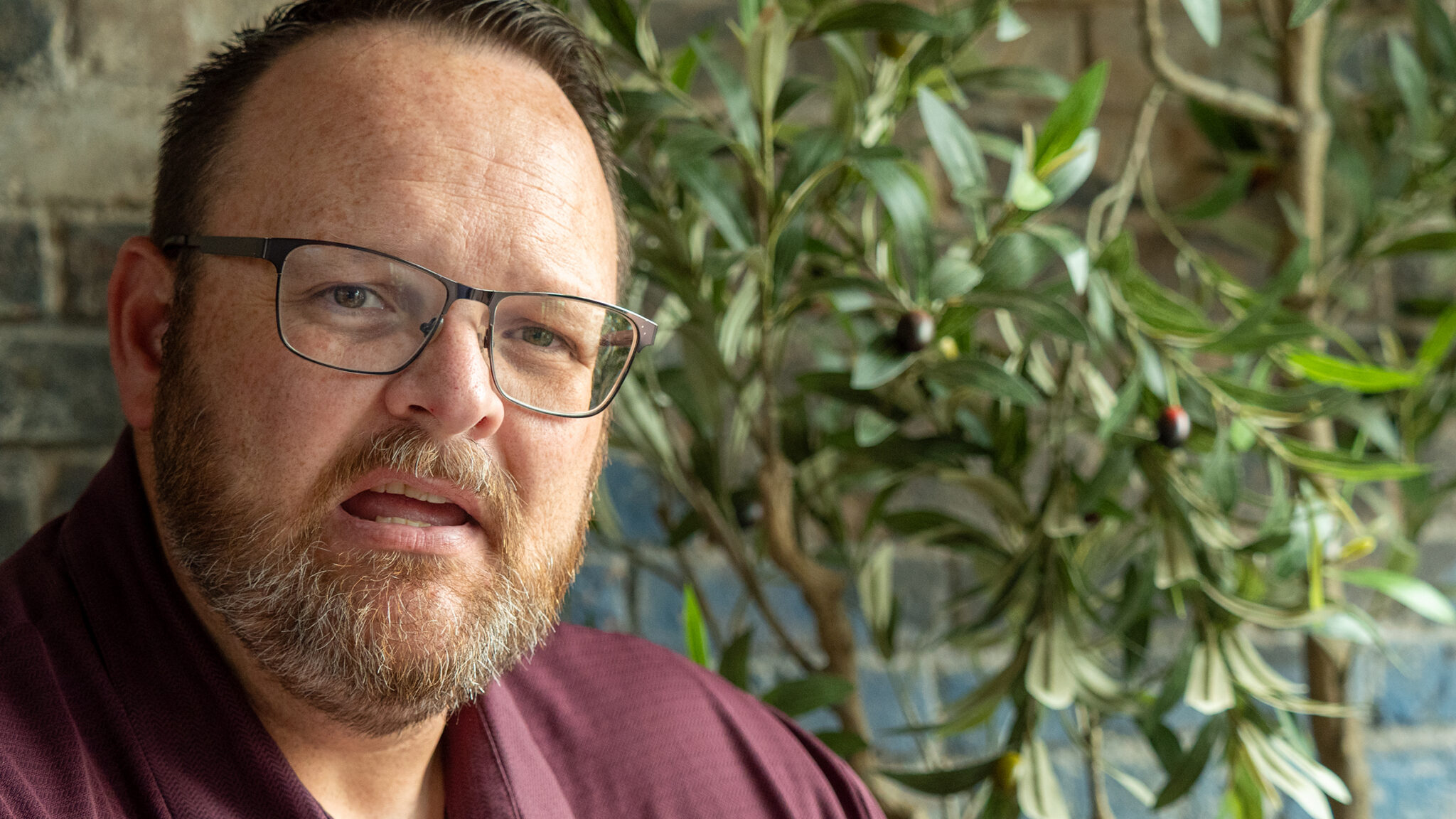
Photo by Sherman Smith/Kansas Reflector: Micah Bunce, an investigator for the Salina regional public defender’s office, is suing three police officers and a former deputy prosecutor in federal court. He accuses them of fabricating a perjury charge to try to get him fired last year.