On Aug. 7 in Allen County, after the heat of the day passed, Joey Berntsen and his sisters were loading last season’s grain to sell. Harvest was soon, demand was high, and all that stood between his family’s farm and a good sale was a bridge in the grain. He climbed in to clear it with a PVC pipe, and in seconds it collapsed, pulling him down all the way to his neck.
“Another foot, I would have been breathing grain,” Berntsen said.
With one hand still above the surface and his phone in his shirt pocket, Berntsen told his sister Lacinda to call Joe Meiwes, a volunteer firefighter, then to call 911 “because I’m stuck,” Berntsen recalled, “and I knew I was stuck.”
News moved fast. Katelyn Meiwes, president of the Allen County Farm Bureau, said her husband, Joe, a member of the Moran Volunteer Fire Department, was out the door within minutes after receiving the call from Joey’s sister.
“My husband was helping me cook dinner, and he got the call from Joey’s sister,” Meiwes said. “I just said, ‘What’s wrong?’ He said, ‘Joey’s in the grain bin.’”
Her husband was one of the first into the bin, laying plywood to keep more grain from burying Joey before the fire departments arrived. Neighbors with scanners heard the dispatch and drove over. By the end of the night, roughly 30 volunteers had shown up.
“We just live in that kind of community, and we’re blessed,” Meiwes said.
When training meets reality
At the Iola Fire Department, Lt. Andy Hill and his crew were eating dinner when they got the call. When Hill arrived on scene and peered into the bin, he couldn’t see Berntsen.
“They had told us waist deep. So in my mind, that’s what I was thinking,” Hill said. “I didn’t see the victim because he was buried up to his neck.”
Shon Price, a full-time firefighter at Overland Park Fire Department and a part-time instructor and certification coordinator with the Kansas Fire & Rescue Training Institute, responded with Colony Volunteer Fire Department from neighboring Anderson County. Price was among the first instructors when KFRTI brought the grain bin rescue and engulfment training program to Kansas, and he brought both the know-how and the right equipment to the scene.
The initial responders improvised barriers from halved 55-gallon drums, but the grain kept sliding back in on the sloped floor of the bin. Colony’s crew brought coffer dams — interlocking metal panels built for grain rescue. They drove a sledgehammer to bury the panels into the densely packed grain. Once they were set, rescuers could augur out the grain around Berntsen.
“60% of entries lead to fatalities,” Price said. “So the fact that we were able to actually get him out of the grain in about 2 1/2 hours, get him into an ambulance and gone in four hours is significant. And that’s because of this training.”
Hill came back for more KFRTI training after the rescue.
“For every one thing that we did right, I feel like there was four or five things that we could have done better,” Hill said. The class, he added, “helped a lot.”
What changed in Allen County
Berntsen’s rescue changed how fire departments across the county prepare for grain emergencies.
Within days, firefighters, businesses and farmers were reaching out to Meiwes asking what they could do. As Farm Bureau president, she contacted KFRTI to organize a grain bin rescue training for the area’s fire departments and farmers.
“Many of our fire departments received funding and grants to purchase the grain bin safety equipment over the past few months,” Meiwes said. “But we knew it was critical that Allen County Farm Bureau know how to utilize it when they are asked to respond. I learned about Kansas Fire & Rescue Training Institute through word of mouth and reached out to organize the event on behalf of Allen County Farm Bureau.”
Three of Allen County’s fire departments have now secured grain bin rescue equipment with a fourth nominated for a Nationwide Insurance grain bin safety grant. The Iola department went from improvised rescue tubes to 10 proper metal coffer dam panels, with additional sets distributed across the county.
“Brought some awareness to the area for sure,” Hill said. “Everyone’s kind of taken it more seriously since we had that incident, trying to train on it and everything.”
Price provided the Grain Engulfment Rescue training in 2023 and again on Feb. 21. “The departments that responded to La Harpe were phenomenal,” Price said, “and they all mentioned that they had all gone through this training and they wanted to do it again.”
A new simulator for Kansas
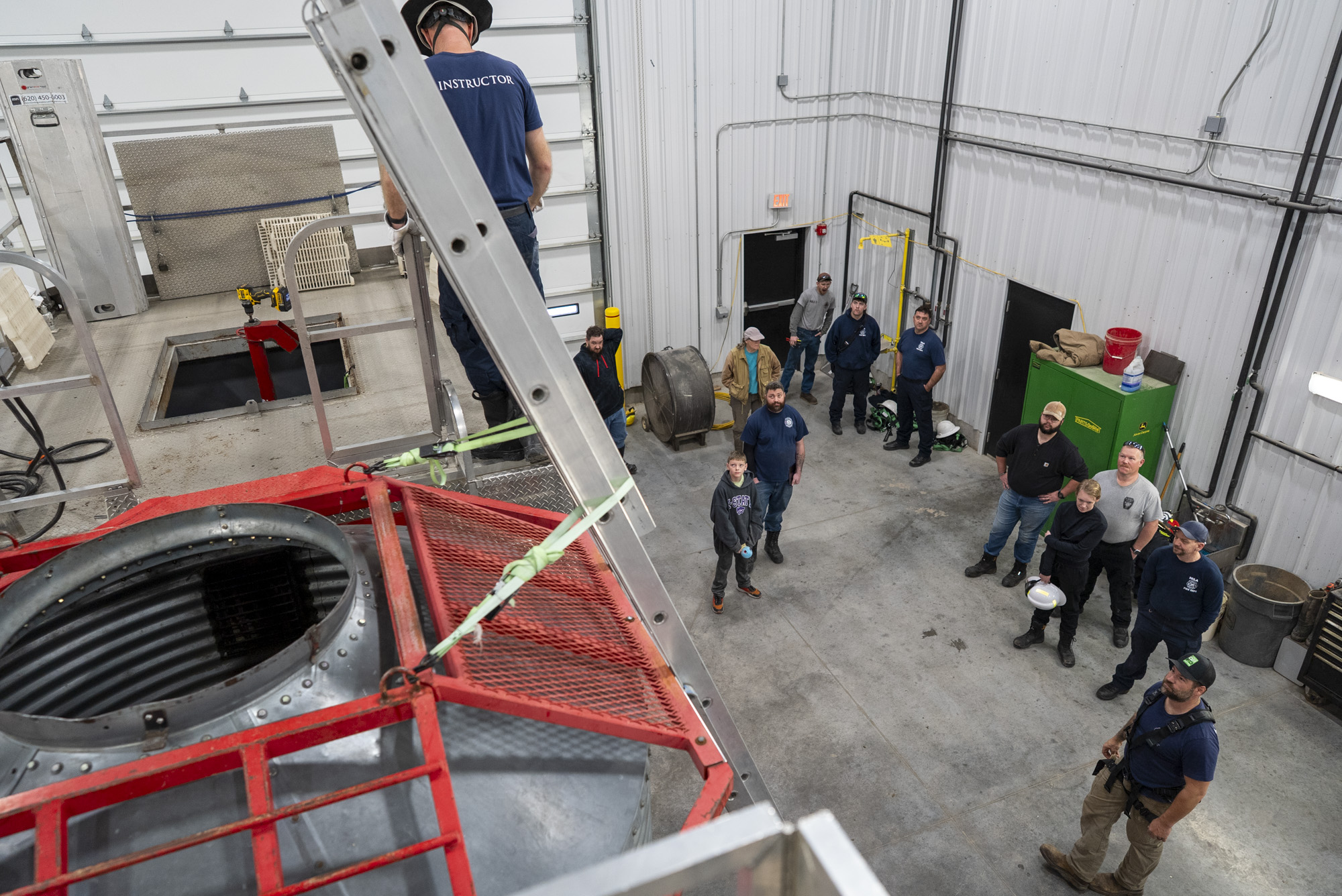
KFRTI recently acquired a new grain rescue training simulator to replace the original trailer, the first of its kind when it launched and has since been used in more than 50 trainings across multiple states.
The new simulator’s flat roof, safety railings, stairs and an open-top design all make for a safety training experience for both Kansas firefighters and KFRTI instructors.
“The new simulator gives us a lot more comfort and stability,” Price said. With the original trailer, instructors managed fall protection, tie-off points and ladder access on top of teaching the rescue. “It gives us an opportunity to get students better hands-on experience,” Price said, to “really focus on training rather than focusing on safety of training.”
Every department that responded to Berntsen’s rescue had been through the program, and every one of them signed up again afterward.
Meiwes said she hopes other counties follow Allen County’s lead.
“We appreciate the support of our community, businesses, farmers and Kansas Fire & Rescue Training Institute that ensured securing equipment and providing training was possible for our firefighters,” she said. “It brings confidence knowing our first responders are willing and able to take action when they receive a call.”
“Farmers and ranchers are the heart of Farm Bureau,” Meiwes added. “Knowing our first responders are prepared simply brings peace of mind.”
KFRTI’s grain bin rescue training is available to fire departments statewide and beyond.
_ _ _
KFRTI instructor Ben Jones with participants in a training Feb. 21. Credit: Justin Gilliland