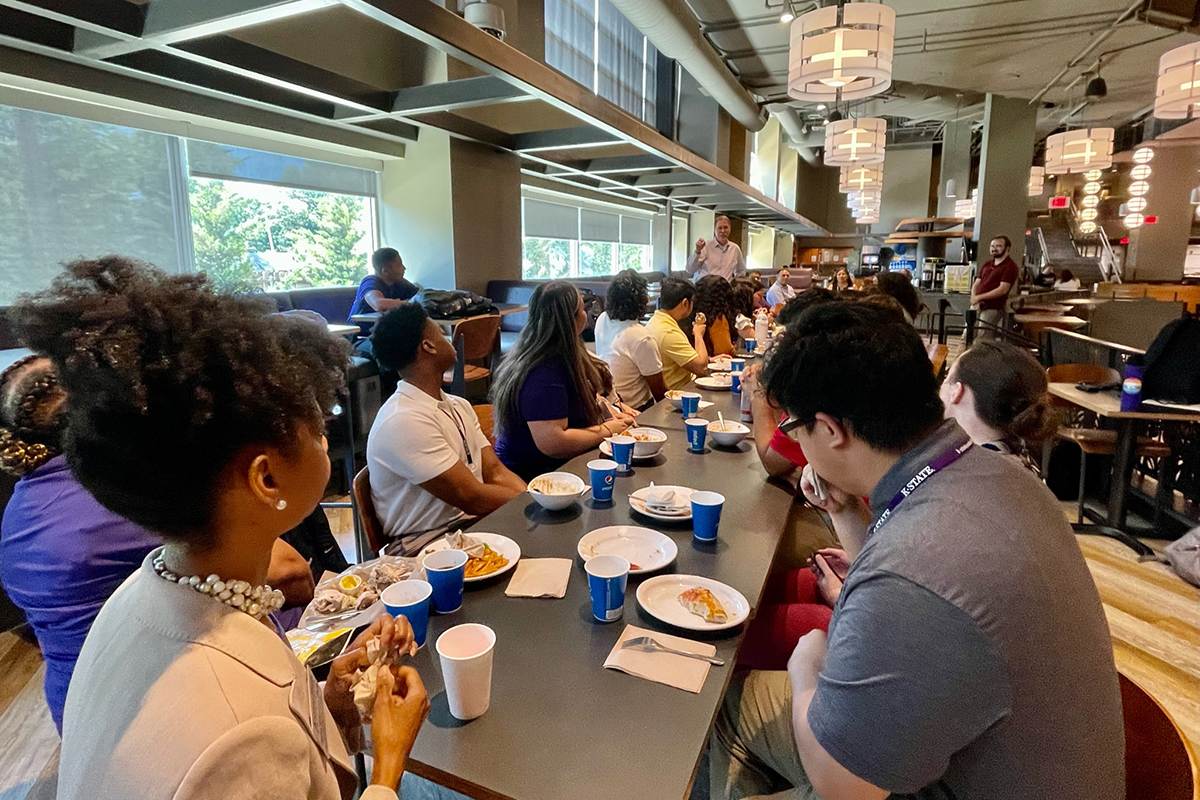
Before this summer, Embry Cole didn’t really know what milling really meant.
But after a week in June at Kansas State University, Cole — a high schooler from Texas who attended the College of Agriculture‘s Feeding Your Future camp— has a much better understanding and passion for the industry, as well as an idea of where he could start a path to his dream career.
Compared to the fall and spring semesters, summers are quieter at K‑State. But they’re never silent, and each summer, K‑State Housing and Dining Services hosts dozens of summer camps and youth experiences.
From academic camps and leadership programs to athletics, music and youth organizations, the experiences bring thousands of middle and high school students to Manhattan each summer.
“These are campers who are staying in our residence halls and eating in our dining facilities,” said Karri Sanderson Tobler, assistant director for conferences and events for Housing and Dining Services. “We’re giving them a taste of K‑State, and if we can give them a stellar experience as a camper, we hope we can get them to imagine what life could be like as a full-time student.”
Camps, activities keep K‑State’s campus busy over summer
The number varies each year, but about 4,000 to 5,000 campers cycle through K‑State’s residence halls for camps every summer, Sanderson Tobler said.
That total doesn’t include campers staying in off-campus housing or the thousands of incoming students who attend New Student Orientation and eat at Kramer or Derby dining centers.
“When students are looking at colleges or even just beginning to consider higher education, every part of the experience can help move the needle,” said Missy Schrader, assistant director of dining services and unit director for Kramer Dining Center. “We keep up that high level of service for campers that we have for our students, and I think a lot of them are often surprised at the choices and the quality of food we have every day.”
Accommodating campers takes dozens of Housing and Dining employees working behind the scenes to ensure each guest has a positive experience.
“We’re an auxiliary service of the university, and when our staff can continue working to provide these services for our summer camps, we’re able to generate revenue that helps keep costs lower for K‑State students during the school year,” Sanderson Tobler said.
Giving future Wildcats a taste of K-State
Although experiences like the College of Agriculture’s Feeding Your Future summer camp aren’t primarily designed to recruit students, they’re a great avenue for young students to explore a field of interest offered by K-State.
Deana Core, assistant dean and director of recruitment for K‑State’s College of Agriculture, coordinates the college’s annual Feeding Your Future camp. She said some of the college’s “hidden gem” programs — like feed and pet food science, milling science and bakery science — may often not be as well known to students or families who aren’t already familiar with those areas.
Bringing campers to campus, then, can be a spark to a career they never even imagined.
“Our campers get the opportunity to see, touch, feel and even smell what we produce here on campus,” Core said. “They experience things they can’t get anywhere else because they have a front-row seat to the innovation and research.
“Anyone can see these experiences online or in a video, but actually making pet food treats yourself and running them through the process, or watching grain go into the mill and come out as flour, is a unique experience to K-State.”
Planting a seed for K-State
The best part of that approach is that in a summer camp environment, there’s no pressure or agenda to visiting campus, said Patrick Winter, associate vice provost and executive director of recruitment and admissions for K‑State.
It’s just plain fun.
“The students just get to be here,” Winter said. “We know we’ve got great partners around campus who are going to put on tremendous events that engage students. Whatever the focus of a particular camp is, it can create an authentic K-State experience for them, and we’re appreciative for that.”
That kind of experience helps build an emotional connection to campus — one Winter’s recruitment team hopes to foster with every prospective student. Typically, that starts at a distance through brochures, high school outreach and social media campaigns, with the ultimate goal of encouraging potential students to visit campus and experience K‑State for themselves.
But through the university’s hosted summer camps, students can skip right to that feeling.
“There’s something about that experience that helps build an emotional connection with the university,” Winter said. “We’re big fans of the fact that so many people around campus are doing these kinds of events that expose students to campus early so they can have that first K-State memory and, hopefully, want to know more down the road.”
Cole, who will be a high school junior this fall, still isn’t sure where he’ll go to college or what he’ll study. He still has a couple of years for that decision, and he’s exploring his options around the country.
As he wandered through Kramer Dining Center one day during his camp, though, he knew at least one school would make his final mix.
“I hadn’t really thought about K‑State before this camp, but being here really opened my eyes to a lot of the different things I could do,” Cole said. “I’m excited to explore some of those options, maybe someday at a place like this.”