Gas was seventeen cents a gallon; a bushel of corn brought $1.53, World War II had just ended, and tickets to the Wild Bill Hickok Rodeo were $1.50.
It was 1946, the first year of the Wild Bill Hickok Rodeo in Abilene, Kansas.
This year, the rodeo celebrates its eightieth birthday. It’s endured through highs and lows, rebuilding itself, and enduring as long-standing entertainment for the community and surrounding area and as professional competition for cowboys and cowgirls.
Held in conjunction with the fair, in its first year it was held for one day, Tuesday, August 6, 1946, at Tom Smith Stadium, with 53 cowboys from 11 states competing. Clyde S. Miller, a well-known rodeo producer, was in charge. Five performances took place, with cowboys competing in bareback riding, bronc riding, bull riding, calf roping, and bulldogging (steer wrestling). Each cowboy competed three times over the course of five performances, with the steer wrestlers competing four times. Prize money was a whopping $4,000, a lot of money at the time, and competition was sanctioned by the Rodeo Cowboys Association, forerunner to the PRCA.
Community members got involved. They were asked to “go western for the rodeo,” wearing western attire, but that, for the men, “it is not necessary to grow whiskers,” according to an article in the Abilene Reflector newspaper. A contest was held for the best beard and the most artistically trimmed beard, with first prize for both contests being five dollars!
In 1948, rodeo handbills, some including free tickets, were dropped from a courtesy plane “droning” over eight communities. Of the 10,000 handbills dropped, 1,000 of them included the tickets.
Bucking horses and bulls in the early days of professional rodeo weren’t always bred and born to buck. For Abilene, Bill Miller, son of producer Clyde Miller, purchased a herd of “wild horses” from a Wyoming rancher. Half of the herd had never been ridden; the other half had appeared at Cheyenne Frontier Days before being hauled to Abilene. “These horses,” Bill Miller said, are the herd “upon which many of the nation’s top cowpokes will risk injury and even death to win a portion of the prize money.”
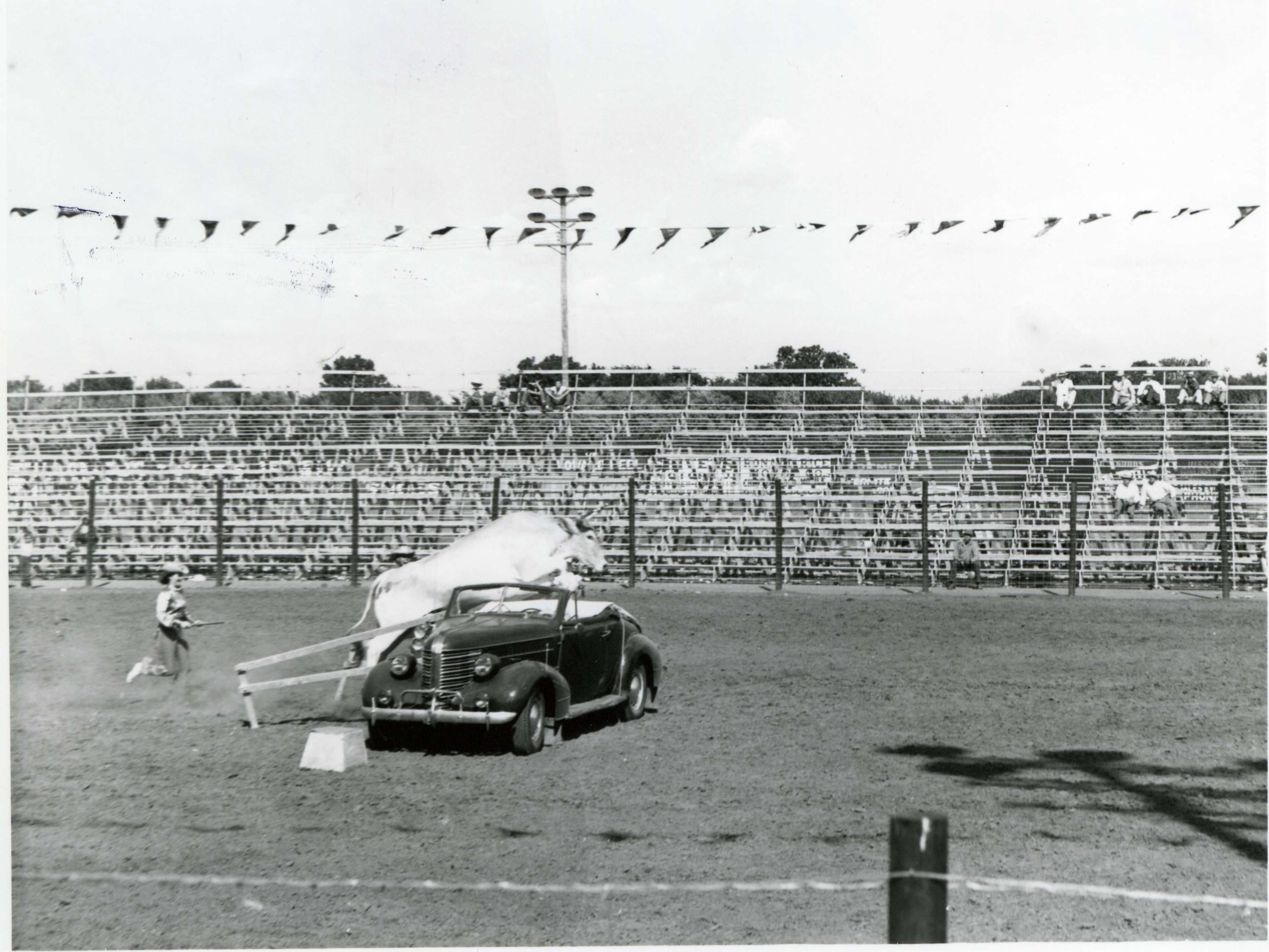
Early day entertainment at the rodeo included such acts as the “quadrille – cowboys and cowgirls’ dance of the range on horseback,” – Charley Shultz and his “bucking Ford,” a Brahma bull pulling a car, trick and fancy riding, and trick and fancy rope spinning.
Before the advent of recorded music, rodeos had live bands, and Abilene was no different. The Wild Bill Hickok Cowboy Band, the “pride of Abilene,” was organized in the 1940s and played live music at the rodeo. They also marched in Washington, D.C. in January 1953 for President Eisenhower’s first inaugural parade.
In the 1970s, the rodeo fell into hard times, with low attendance and waning interest. In 1986, a four-member advisory committee was formed, with Kenny Chase, Dan Coup, Sidney Hammond, and Bruce Kogler (Kogler has passed). Hammond still serves on the rodeo committee.
They worked to revitalize the rodeo. Their biggest job was to add sponsors to the rodeo (prior to that, the rodeo hadn’t had business sponsors). With increased funding, they were able to increase purse money and replace the arena fence. They also started the belt buckle series, an annual buckle that featured a local cowboy or cowgirl.
It worked. The rodeo was nominated as one of the PRCA’s Top 5 Medium-Size Rodeos of the Year five times (1995, 2001-02, 2010-11.)
The rodeo has striven to be one of the best in the state and in the nation, hiring some of the best in the industry. Andrews Rodeo Co., well-known for their bucking bulls and horses, was hired as the stock contractor in 1999. Specialty act entertainment has been top quality acts, like rodeo clown Lecile Harris and specialty acts Leon and Vickie Adams, John Payne, the One Arm Bandit, and trick riders Dusta Kimzey-O’Connell and Melissa Riddle Navarre.
Many of the contractors who have worked the Abilene rodeo are in the ProRodeo Hall of Fame in Colorado Springs. They include former announcers Phil Gardenhire and Hadley Barrett; rodeo clown Lecile Harris; bullfighter Rob Smets; specialty acts Leon and Vicki Adams and Tommy Lucia, all-around cowboys Ken Roberts and Gerald Roberts, and stock contractors Beutler Bros., Mike Cervi, Harry Vold, and the current contractor, Sammy Andrews.
Prize money has increased to $10,000 per event, for a total of $100,000. The number of contestants has stayed steady, at about 550.
And the stands are full of fans, which is the indication of success.
“We love to see full grandstands,” said DeLynn Farson, rodeo committee member. “We work hard to make our rodeo the best it can be, and when people come to it, they’ve voted with their dollar that it’s the entertainment they’ve chosen.”
A lot has changed since those early days of the Wild Bill Hickok Rodeo. But some things don’t change. The rodeo has provided a place for cowboys to compete, to earn money, and a place for people to be entertained, to enjoy themselves, and to be reminded of the Old West and the traditions of Abilene.
The 80th Wild Bill Hickok Rodeo is July 28-31 in Abilene at the fairgrounds. Performances start at 7:30 pm nightly. Tickets are $8 for children ages 4-10 and $12-$15 for adults.
Tickets are available online at WildBillHickokRodeo.com, at West’s Country Mart, Lumber House, Pioneer Farm and Supply, and at the gate.
_ _ _
Photo: A bull jumps over a car as part of the entertainment at an early Wild Bill Hickok Rodeo. The rodeo celebrates its 80th anniversary this year. Photo courtesy Dickinson Co. Historical Society.